






















TL;DR:
- Using an eSIM in Spain enables instant activation, cost savings, and eliminates the hassle of physical SIM cards for travelers. It supports most modern unlocked smartphones, allowing seamless connectivity across Spain and neighboring countries with flexible plans and quick setup. This digital solution enhances spontaneous travel and simplifies multi-country trips by providing reliable, eco-friendly mobile access before and during your visit.
Arriving in Spain and getting stuck at the airport hunting for a SIM card kiosk is a frustrating way to start any trip. International roaming fees often catch travelers off guard, with charges that can reach $10 or more per day just for basic data access. An eSIM, the digital alternative built directly into your smartphone, removes that entire problem. This article breaks down exactly what eSIMs are, how they work across Spain’s networks, which plans offer the best value, and how to get yours active before your plane even lands.
Table of Contents
- What is an eSIM and how does it work in Spain?
- Top benefits of using an eSIM for travel in Spain
- Comparing Spain eSIM offerings: Price, coverage, and features
- How to install and activate your Spain eSIM: Step-by-step guide
- Common questions and troubleshooting Spain eSIM issues
- A seasoned traveler’s take: The real-world freedom eSIM unlocks in Spain
- Get your Spain eSIM in minutes with Esimglobe
- Frequently asked questions
Key Takeaways
| Point | Details |
|---|---|
| No roaming surprises | A Spain eSIM means you avoid hefty international roaming fees and hidden charges. |
| Fast, easy activation | You can activate your eSIM for Spain in minutes, often before landing, with no physical SIM swap needed. |
| Flexible travel solution | An eSIM for Spain gives you freedom to switch data plans and extend coverage to nearby countries on-the-go. |
| Essential for modern travelers | eSIM technology is now supported on most recent smartphones, making travel connectivity simpler than ever. |
What is an eSIM and how does it work in Spain?
The term eSIM stands for embedded SIM. Unlike a traditional nano or micro SIM card that you physically slot into your phone, an eSIM is a small chip already soldered inside your device. There is no card to handle, no ejector pin needed, and no risk of dropping a tiny plastic rectangle on the airport floor.
In Spain, eSIM technology works by connecting to local mobile networks through a digital profile stored on your phone. When you purchase an eSIM plan for Spain, the provider sends you a QR code. You scan that code with your phone’s camera, the digital profile installs automatically, and your device connects to a Spanish network. The whole process typically takes less than five minutes.
eSIMs are compatible with most modern unlocked smartphones, enabling fast network switching without a physical SIM card.
Device compatibility is the first thing to check. iPhones from the XS model onward all support eSIM. On the Android side, most flagship models released after 2019 from Samsung, Google Pixel, and other major brands include eSIM support. A few key things to confirm before purchasing any plan:
- Your phone must be carrier unlocked (not locked to your home network)
- The eSIM option must appear in your device settings under “Mobile Data” or “Cellular”
- Your phone’s operating system should be updated to the latest version for best compatibility
- Dual SIM support means you can keep your home number active while the Spain eSIM handles data
- Some older budget Android phones do not support eSIM even if they are recent releases
Spain’s main mobile networks, including Telefonica’s Movistar, Vodafone, and Orange, all support eSIM technology. Coverage across major cities like Madrid, Barcelona, Seville, and Valencia is strong. Rural areas and mountain regions like the Pyrenees may see reduced signal strength, which is true of any network in those zones.
One often overlooked advantage: you can install your eSIM for Spain days before departure while sitting at home on Wi-Fi. The profile installs instantly, but activation only begins once you land and the device connects to a Spanish tower. You arrive connected without a single stop at a kiosk.
Top benefits of using an eSIM for travel in Spain
The practical case for using an eSIM in Spain is straightforward. Here is why travelers are moving away from physical SIM cards at a rapid pace.
-
Instant connectivity on landing. The moment your plane touches down in Madrid or Barcelona, your phone connects to a local Spanish network. No waiting at a store, no filling out forms. You can open maps, call a taxi app, or message your hotel immediately.
-
Significant cost savings. Standard international roaming packages from major US or UK carriers average between $10 and $15 per day. A typical Spain eSIM data plan costs a fraction of that. Travelers using eSIMs can instantly switch between local networks and use data plans suited to their needs, slashing roaming costs by a substantial margin.
-
No physical SIM management. Losing a SIM card abroad is more common than people admit. A tiny card drops between the seat cushions, or you forget which pocket holds the ejector pin. eSIMs remove that risk entirely.
-
Flexible top-up options. If you burn through your data allowance faster than expected (streaming that Real Madrid match will do it), most eSIM providers allow you to purchase an additional plan digitally without visiting any store.
-
Multi-country coverage. Many Spain eSIM plans extend coverage into neighboring countries. If your trip includes a weekend in Lisbon or a day trip to Andorra, a single eSIM plan may cover all of it.
-
Keeping your main number active. Because eSIM handles data and your physical SIM handles calls and texts, you retain access to WhatsApp, banking apps, and two-factor authentication codes on your regular number the whole time.
-
Environmental factor. No plastic card production, no packaging waste. A digital profile has zero physical footprint.
Pro Tip: Before purchasing any prepaid Spain eSIM, confirm your exact travel dates and daily data habits. A light browser and map user needs far less data than someone streaming video or working remotely. Matching plan size to actual usage prevents overpaying for unused gigabytes.
The flexibility factor deserves extra attention. Traditional SIM swaps require either buying a local card in Spain (which means finding a store during business hours) or relying on expensive roaming from your home carrier. An eSIM gives you a third option that combines local pricing with the convenience of buying from home, in advance, in your own language.

Comparing Spain eSIM offerings: Price, coverage, and features
To avoid getting lost in a maze of offers, compare the essentials that actually matter for your trip. Plan selection comes down to four core variables: data allowance, validity period, price, and geographic coverage.
| Plan size | Validity | Typical price (USD) | Activation method | Coverage area |
|---|---|---|---|---|
| 1 GB | 7 days | $4.50 to $6.00 | QR code, instant | Spain only |
| 3 GB | 15 days | $10.00 to $13.00 | QR code, instant | Spain only |
| 5 GB | 30 days | $15.00 to $19.00 | QR code, instant | Spain + EU |
| 10 GB | 30 days | $24.00 to $30.00 | QR code, instant | Spain + EU |
| 20 GB | 30 days | $38.00 to $45.00 | QR code, instant | Spain + EU + extras |
Leading Spain eSIM products offer varying packages such as 1GB for 7 days, with instant QR code delivery, making them accessible for both short city breaks and extended stays.
Statistic callout: Compared to standard international roaming rates, eSIM data plans for Spain typically cost 60 to 80 percent less per gigabyte. A traveler spending two weeks in Spain using 5GB of data would pay roughly $15 to $19 on an eSIM plan versus an estimated $70 to $100 in roaming charges from a typical US carrier.
For travelers planning to cross into Portugal, separate eSIM coverage ensures you stay connected through Lisbon, Porto, and the Algarve. A Portugal eSIM for multi-country trips is worth checking if your itinerary goes beyond Spain’s borders. Similarly, if your trip includes the small principality of Andorra tucked between Spain and France, reviewing Andorra eSIM options before departure prevents connectivity gaps in that mountain region.
A few additional factors worth comparing across plans:
- Voice and SMS inclusion. Most travel eSIM plans are data-only. Calls and texts route through your physical home SIM or apps like WhatsApp and FaceTime.
- Hotspot/tethering support. If you plan to share your connection with a tablet or laptop, confirm the plan explicitly allows it.
- Network tier. Some budget plans connect only to 3G or limited 4G networks. Plans that clearly state 4G LTE or 5G access provide faster speeds in Spain’s major cities.
- Auto-renewal or one-time purchase. Most travel eSIM plans are one-time purchases with no subscription, which simplifies budgeting.
How to install and activate your Spain eSIM: Step-by-step guide
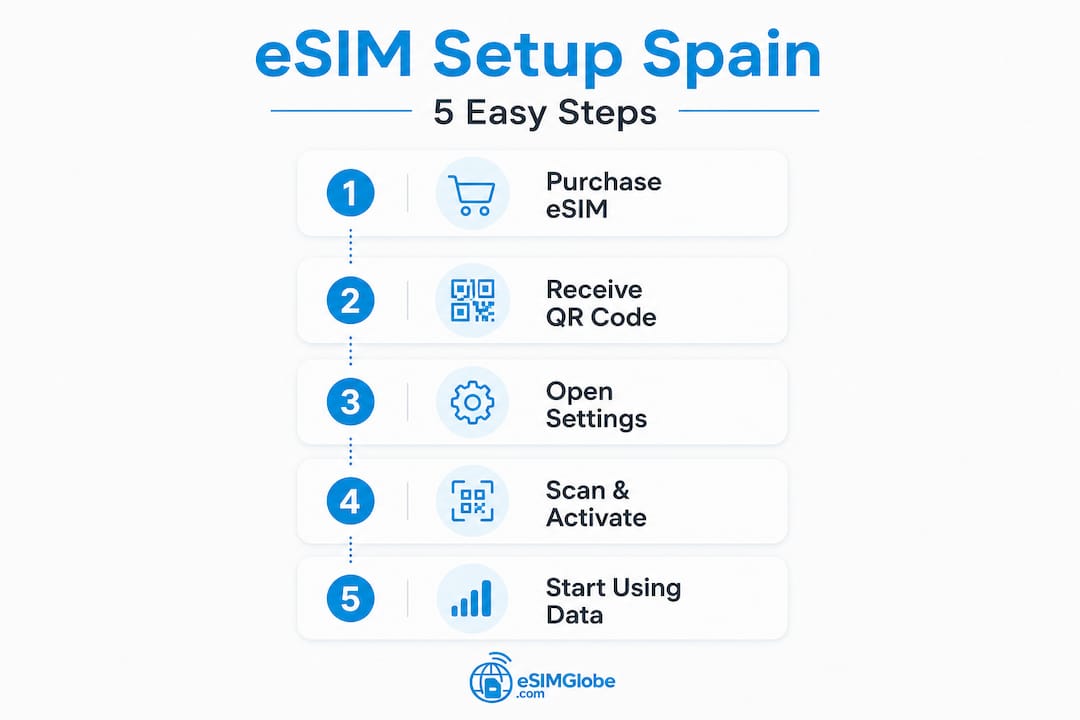
After choosing the right eSIM, here is exactly how to get it working before or after you arrive in Spain. The process is standardized across most providers and devices, with minor variations depending on your phone’s operating system.
-
Choose your plan. Select the data size and validity period that matches your trip length and usage habits.
-
Complete the purchase. Pay online via the provider’s website or app. You receive a confirmation email almost immediately.
-
Locate your QR code. The QR code arrives either in your confirmation email or within a provider app. Save it or take a screenshot right away.
-
Open your phone’s settings. On iPhone, navigate to Settings > Cellular > Add Cellular Plan. On Android, go to Settings > Network & Internet > SIM cards > Add eSIM.
-
Scan the QR code. Point your phone’s camera at the QR code displayed on your screen or printed copy. The profile installs automatically.
-
Label the new line. Your phone will prompt you to name the new line. Labeling it “Spain Data” avoids confusion later.
-
Set data preferences. Select the new eSIM as your primary data line. Keep your physical SIM set for calls and texts.
-
Wait for activation. If you installed before departure, the plan activates when your phone connects to a Spanish tower upon arrival. If you are already in Spain, activation is immediate.
eSIMs are typically activated via QR code, with setup taking under 5 minutes if your device is compatible, making the process faster than standing in any airport SIM card line.
If you lose Wi-Fi during installation: Pause the process. Do not close the settings screen. Reconnect to Wi-Fi and resume from the same screen. Most phones hold the partial installation state for several minutes.
If you need to revert to your home SIM: Your physical SIM never deactivates. Simply go back to your cellular settings and select the home SIM as the primary data line. Both profiles remain stored on your device.
Detailed activation steps are also available directly on the Spain eSIM activation guide page, which includes device-specific screenshots and troubleshooting notes.
Pro Tip: Screenshot your eSIM QR code and save the confirmation email to a folder labeled “Spain Trip.” If you get a new phone mid-trip or accidentally delete the eSIM profile, having that QR code backed up means you can reinstall without contacting support.
Common questions and troubleshooting Spain eSIM issues
Even the smoothest tech can trip us up on the road. Here is how to solve the most common eSIM snags travelers face in Spain.
Frequent problems and their fixes:
-
QR code won’t scan. Clean your camera lens. Display the QR code on a bright screen at full brightness. Try scanning from a slightly different distance, about 20 to 30 centimeters. If the code is on the same device you are scanning with, display it on another screen first.
-
Data not available after activation. Open Settings and confirm that data roaming is turned on for the eSIM line. In Spain, your eSIM profile is technically “roaming” relative to the issuing provider’s network, so that toggle must be active.
-
eSIM not found on device. Restart the phone after installation. If the eSIM profile still does not appear, confirm your device is carrier unlocked. If a device doesn’t support eSIM, or if the eSIM plan isn’t recognized, double-check whether your smartphone is carrier-unlocked, as locked devices cannot load third-party profiles.
-
eSIM profile deleted by accident. Contact your provider immediately. Most providers can reissue a QR code, but some eSIM profiles are single-use. This is exactly why saving a screenshot beforehand matters so much.
-
Slow data speeds. Check that your plan supports 4G LTE and that you have selected the correct APN (Access Point Name) settings if your device requires manual entry. The provider’s confirmation email usually includes APN details.
A practical compatibility checklist for Spain eSIM covers the most common device and carrier combinations, helping you confirm workability before purchase.
Pre-trip compatibility checklist:
- Phone is fully unlocked by your home carrier
- Device settings show an “Add eSIM” or “Add Cellular Plan” option
- Phone OS is updated to the latest version
- You have access to a stable Wi-Fi connection for installation
- Confirmation email and QR code are saved in a backup location
Pro Tip: If you are unsure whether your device supports eSIM, search your phone model followed by “eSIM support” before purchasing any plan. Most phone manufacturers list eSIM capability on their official specification pages. This takes 60 seconds and saves potential frustration later.
Customer support from reputable eSIM providers typically responds within a few hours via chat or email, which is fast enough to resolve most installation issues before they ruin travel plans.
A seasoned traveler’s take: The real-world freedom eSIM unlocks in Spain
Beyond troubleshooting, let’s zoom out to what eSIM for Spain really means for the way you experience travel.
The most underrated aspect of eSIM technology is not the cost savings, though those are real. It is the mental space it frees up. Traditional SIM logistics occupy more cognitive energy than travelers realize. Which carrier do I use? Where is the nearest store? Is it open on Sunday? Did I pack the ejector pin? Every one of those questions disappears with a digital profile installed before departure.
Spain rewards spontaneous decisions. You are in Seville and someone mentions the fast train to Madrid leaves in an hour. You are in Barcelona and you notice a day trip to Montserrat fits your schedule. Booking any of these in real time requires internet access. With traveler experiences with eSIM Spain consistently pointing to immediate connectivity as the top benefit, the pattern is clear: connectivity is what makes spontaneous plans possible.
Consider a specific scenario many travelers encounter. You decide late in your Spain trip to extend into Portugal, specifically to catch a weekend in Porto. Without an eSIM, this means finding a Portuguese SIM card, dealing with a Portuguese phone store, and potentially losing half a day. With an eSIM, you purchase a Portugal plan online from a cafe in Seville while finishing your coffee. By the time you board the train, your phone is ready for Porto.
There is also the issue of what veteran travelers describe as “SIM card anxiety.” Experienced travelers who have spent years swapping physical cards across dozens of countries report that the small plastic card becomes a disproportionate source of stress. Losing it means losing connectivity. Damaging it means the same. The embedded nature of eSIM technology eliminates that specific category of travel problem entirely.
For Eurotrips that connect Spain with France, Portugal, and Germany in a single itinerary, the multi-country eSIM plan structure provides seamless coverage without juggling multiple physical cards. When travel plans shift unexpectedly, which they always do, an eSIM user simply purchases an additional plan for the new country. No store visit, no downtime.
The conventional advice for staying connected abroad has always been “buy a local SIM on arrival.” That advice made sense when eSIM was not widely available. In 2026, with most modern smartphones supporting eSIM natively, the better advice is: buy your digital plan before you leave home, arrive ready to go, and spend your first hour in Spain actually exploring rather than standing at a kiosk.
Get your Spain eSIM in minutes with Esimglobe
There is no need to wait until you land to sort out your Spain connectivity.
Esimglobe offers a straightforward way to buy your Spain eSIM instantly, with plans starting at 1GB and scaling up based on your trip length and data needs. Every plan delivers the QR code immediately after purchase, directly to your inbox. Installation takes under five minutes on any compatible device. The platform supports multiple currencies including USD and EUR, and the full compatibility guide is available on-site so you can confirm your device works before completing any purchase. Whether your itinerary covers only Spain or extends across Portugal and beyond, see Spain eSIM plans and select the option that fits your actual trip. Purchase before your departure date to guarantee a connected arrival.
Frequently asked questions
Will my phone work with a Spain eSIM?
Your phone must be unlocked and support eSIM; most modern unlocked smartphones are compatible, including iPhones from XS onward and many recent Android flagship models.
Can I keep my WhatsApp or main number with an eSIM in Spain?
Yes. eSIM lets you use mobile data abroad while retaining access to your main number for calls and SMS, so WhatsApp and two-factor authentication codes continue working normally.
Can I use my Spain eSIM in other European countries?
Many Spain eSIM plans also include coverage in Portugal, Andorra, and nearby countries; check your specific plan details, and note that many eSIM plans support data coverage across several European nations.
What should I do if my eSIM QR code won’t scan?
Clean your camera lens, confirm you have an active Wi-Fi connection, increase screen brightness on the device displaying the code, and contact your provider to resend or guide troubleshooting if the problem continues.