






















For most travelers, EsimGlobe is the best eSIM for Belarus, thanks to instant email delivery, clear pricing across 1 to 30 plus day plans, and network access built for both Minsk and rural routes. Budget short-stay travelers can also look at GoMoWorld, while those heading off the main highways benefit most from a dual-network setup rather than chasing the cheapest per-gigabyte number.
TL;DR:
- EsimGlobe provides dual-network access with automatic carrier fallback, ensuring reliable coverage outside Minsk and rural routes.
- Its plans start at 1GB for 7 days and scale up to longer durations, delivered instantly via email, suitable for various trip lengths.
- When choosing an eSIM, prioritize network coverage disclosure and dual-network support over the lowest sticker price or unlimited claims.
- For rural travel or crossing smaller towns, a dual-network eSIM connecting to both A1 and MTS offers the most dependable signal.
- Travelers should match their data needs to trip length, with 5-10GB recommended for a week, and always test and set up the eSIM before departure.
Table of Contents
- What Is the Best eSIM for Belarus Right Now?
- How Do Belarus Mobile Networks Differ (A1, MTS, Life:)?
- How Should You Choose the Right eSIM Plan for Belarus?
- What Do Belarus eSIM Plans Actually Cost?
- How Do You Activate an eSIM for Belarus?
- Why EsimGlobe Stands Out for Belarus Travel
- Bottom Line: Which eSIM Should You Buy for Belarus?
- An Editorial Take on Choosing an eSIM for Belarus
- Get Your Belarus eSIM Set Up Before You Fly
- FAQ
What Is the Best eSIM for Belarus Right Now?
Picking the best eSIM for Belarus comes down to three things: how many days you’re staying, whether you’re leaving Minsk, and how much data you actually burn through on maps and messaging. EsimGlobe covers that range cleanly, with a dedicated Belarus product line that starts at 1GB for 7 days and scales up for longer trips, delivered by email the moment you complete checkout.
The wider market is crowded. Aggregator sites like esims.io and esimdb list hundreds of Belarus eSIM plans, filterable by price per gigabyte and validity window, which tells you the category is fragmented rather than clearly ranked. Comparison apps on the Apple App Store and Google Play exist specifically because travelers struggle to tell one offer from another. That fragmentation is exactly why network access and plan clarity matter more than shaving a dollar off the sticker price.
Here’s how EsimGlobe stacks up against four other names you’ll run into during your research: GoMoWorld, eTravelSim, GlobaleSIM, and Airalo.
A few things jump out once you line these up side by side.
- EsimGlobe is the only entry here built around a Belarus-specific product page with plan lengths that scale from a week to a month or more, so you are not forced into a one-size package.
- GoMoWorld and Airalo compete mostly on entry price for two- or three-day layover trips, not on data volume or network depth.
- eTravelSim earns its spot if your itinerary treats Belarus as one stop inside a broader Baltic or Eastern Europe loop.
- GlobaleSIM shows up on nearly every aggregator list with middle-of-the-road pricing, which makes it a safe but unremarkable choice.
None of these four beat EsimGlobe on the combination that actually decides a trip: coverage once you leave the capital, plan flexibility, and delivery speed. That combination is why it leads this list rather than tying for first.
How Do Belarus Mobile Networks Differ (A1, MTS, Life:)?
Belarus runs on three main carriers, and they do not perform the same everywhere. A1 and MTS both carry strong urban footprints in Minsk, Gomel, and Brest, with A1 generally viewed as the stronger performer for 4G speed in city centers. Life:) fills in secondary cities well but tends to thin out faster once you’re on rural roads.
5G exists in parts of Minsk, but it’s not something you should count on outside the capital as of mid-2026. If your trip is Minsk-only, network choice barely matters. If you’re driving toward Brest, the Belovezhskaya Pushcha forest, or smaller towns, it matters quite a bit.
A single-network eSIM roams on whichever carrier the provider has a deal with. If that carrier’s coverage thins out where you’re headed, your data thins out with it.
The practical fix is dual-network or multi-network access, where the eSIM automatically falls back to a second carrier if the first loses signal. Industry sources tracking Belarus eSIMs specifically call out dual-network setups covering both MTS and A1 as the most reliable way to avoid dead zones outside the capital, and a few providers separately route through Life:) for extra secondary-city reach.
Here’s what that looks like across the field:
- EsimGlobe builds Belarus plans around dual-network access, giving you automatic fallback between local carriers instead of a single point of failure.
- Wiiline and AlpineSIM advertise per-destination or unlimited-style packs but don’t consistently publish which specific local carriers they connect to, so check the fine print before buying if rural coverage matters to you.
- eSIMX and Yesim list generous data caps on paper, but their listings typically don’t disclose dual-network fallback either.
Fact: providers that connect to both A1 and MTS simultaneously give you an automatic backup carrier the moment one signal drops, something a single-network eSIM simply cannot do.
If a provider’s page doesn’t say which local networks it reaches, that’s a real gap, not a technicality. Email support and ask before you buy, especially if your trip includes anything outside Minsk.
How Should You Choose the Right eSIM Plan for Belarus?
Matching your plan to your actual trip is the single biggest lever you control, and it’s the one most travelers skip. Monito’s Belarus eSIM research makes this point directly: people routinely overbuy by grabbing a 30-day plan for a five-day visit, paying for data they’ll never touch.
Work through this checklist before you buy:
- Count your actual days in Belarus, not your total trip length if Belarus is one stop among several.
- Decide if you’re leaving Minsk. Sightseeing-only trips can lean on single-network plans; rural or cross-country routes should prioritize dual-network access.
- Check your hotspot needs. If you’re tethering a laptop or sharing with a travel partner, confirm the plan explicitly allows it. Some cheaper entry plans restrict or block hotspot use.
- Set a data budget. Casual maps-and-messaging use runs light; video calls and navigation-heavy road trips burn through data fast.
- Confirm device compatibility and carrier lock. Older phones and carrier-locked handsets from certain US carriers won’t accept an eSIM profile at all.
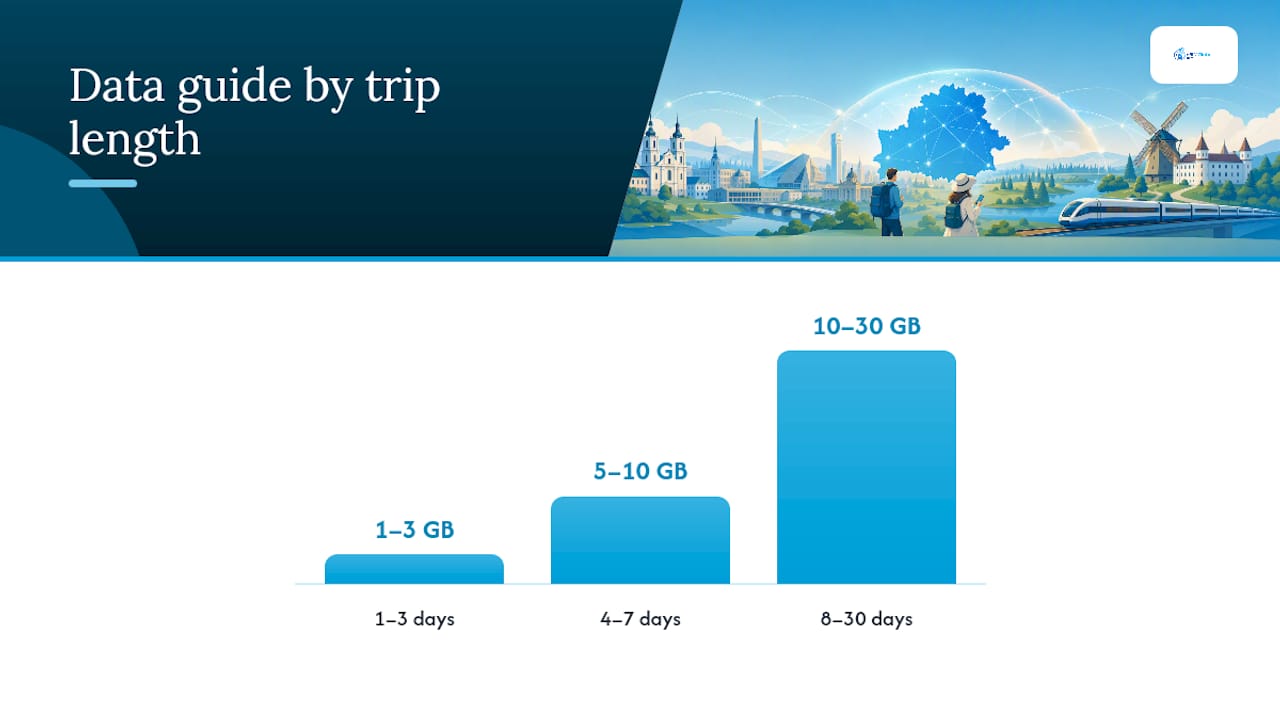
For data sizing, a rough guide by trip length looks like this:
- 1 to 3 days: 1 to 3GB covers maps, messaging, and light browsing.
- 4 to 7 days: 5 to 10GB gives comfortable room for social media and occasional video calls.
- 8 to 30 days: 10 to 30GB suits daily use including navigation, streaming, and remote work check-ins.
Pro Tip: Buy slightly more data than your estimate, not more days of validity. A 10GB/14-day plan for a 7-day trip protects you against a heavy data day; a 30-day plan for a 7-day trip just wastes money on unused validity.
Watch for three red flags while you shop: a provider that won’t name which local network it connects to, an activation process that takes longer than a few minutes to deliver your QR code, and an “unlimited” plan with no visible fair-use terms. Any one of those should push you toward a different listing.
What Do Belarus eSIM Plans Actually Cost?
Prices across Belarus eSIM aggregators swing widely, from well under $1 per gigabyte on bulk plans to several dollars per gigabyte on small, short-validity packs. Aggregators like esimq commonly show 10GB and 20GB offers priced differently depending on validity window, which is exactly where the real comparison needs to happen.
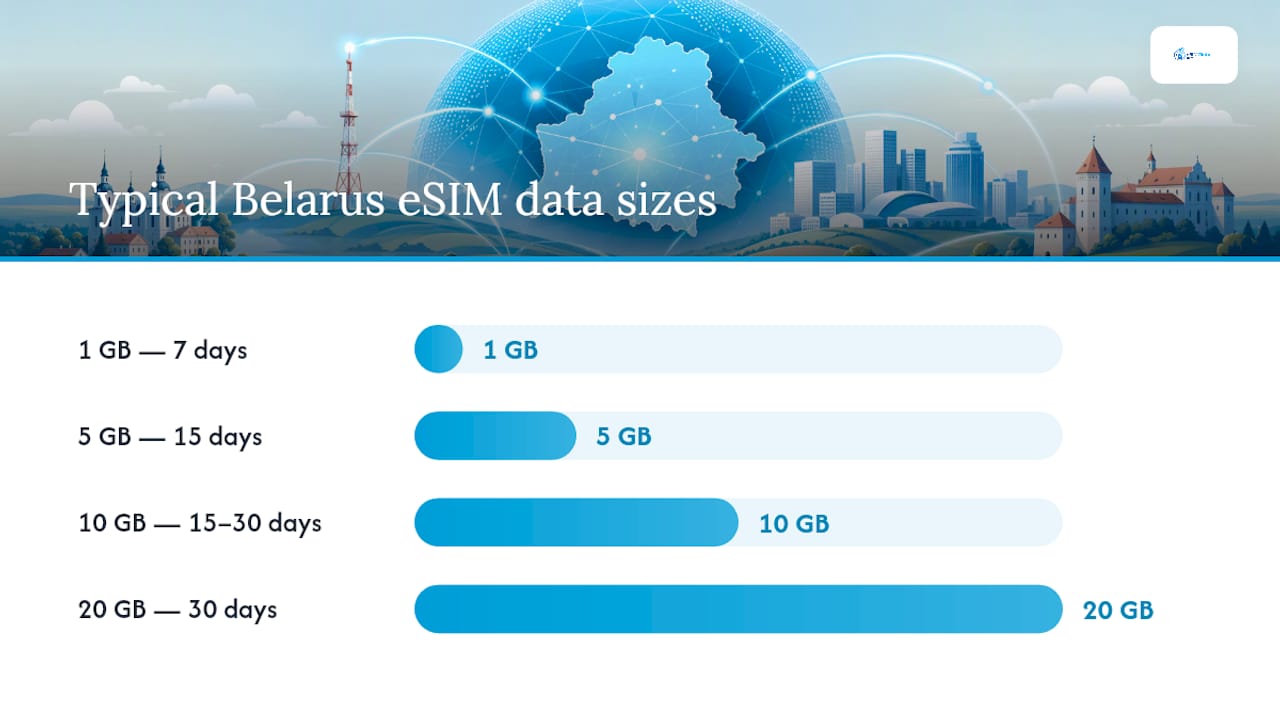
Here’s a representative snapshot of what typical plan sizes look like across the market:
| Data amount | Typical validity | What it suits |
|---|---|---|
| 1GB | 7 days | Layovers, single-city short stays |
| 5GB | 15 days | Standard one-week tourist trip |
| 10GB | 15 to 30 days | Two-to-three week stays with regular navigation use |
| 20GB | 30 days | Long stays, remote work, or heavy hotspot use |
The math that actually matters is price per gigabyte, not sticker price. A 5GB plan priced higher than a 10GB plan from a different provider is the worst deal every time, even if its upfront number looks smaller. Divide total price by total gigabytes, then compare that single number across listings.
Validity length changes the value equation too. A 10GB plan valid for 30 days is worth more to a two-week traveler than a 10GB plan valid for only 7 days, since unused days on a short-validity plan simply expire.
- Watch for “unlimited” plans specifically. FindYourESIM’s research on Belarus eSIMs found that unlimited offers routinely include a fair-use cap, after which speeds drop sharply for the rest of the validity period.
- Treat advertised unlimited data as conditional until the fine print confirms the daily or monthly full-speed threshold.
- A capped 20GB plan at full speed the whole time can outperform a throttled “unlimited” plan in real-world use.
EsimGlobe publishes its Belarus data tiers with the gigabyte amount and validity window stated upfront, which makes the price-per-GB math straightforward instead of buried in fair-use disclaimers.
How Do You Activate an eSIM for Belarus?
Before anything else, confirm your phone supports eSIM and isn’t locked to a carrier that blocks third-party profiles. Most phones from the last several years support eSIM, but carrier-locked devices, especially older US carrier phones, sometimes refuse to install a second profile.
Once that’s confirmed, activation follows a short, predictable sequence:
- Purchase your plan online and choose the data size and validity that match your trip length.
- Receive your QR code and instructions by email, typically within minutes of checkout.
- Open your phone’s cellular settings and scan the QR code to install the eSIM profile.
- Select the new eSIM as your data line while keeping your home SIM active for calls and texts if you’re using dual SIM.
- Test the connection before you leave home, ideally with Wi-Fi off, to confirm data flows before you’re relying on it at the airport.
If something doesn’t connect right away, work through this short troubleshooting list:
- Double-check the APN settings match what the provider’s instructions specify.
- Restart your phone after installing the profile; this fixes a surprising share of activation issues.
- Make sure the eSIM line, not your home SIM, is set as the active data line.
- If the profile still won’t connect, delete and reinstall it using the same QR code rather than requesting a new one first.
Testing before departure matters more than it sounds. A five-minute check at home, with a working Wi-Fi network to fall back on, beats troubleshooting a dead data line at Minsk National Airport. For broader setup habits that carry over to any destination, these eSIM travel tips cover device settings worth checking before any international trip.
Why EsimGlobe Stands Out for Belarus Travel
EsimGlobe’s Belarus product line starts at a 1GB, 7-day plan and scales up from there, with every plan delivered by email the moment checkout completes. That instant delivery matters more than it sounds. Travelers who buy an eSIM the night before a flight, or from the departure gate, need the QR code in their inbox in minutes, not hours.
A few brand-level details separate EsimGlobe from single-country resellers:
- Multi-region support means the same account and process work whether your next trip is Belarus, a neighboring country, or somewhere entirely different.
- Currency and language selection removes the friction of checking out in an unfamiliar currency.
- 24/7 support gives you somewhere to turn if your profile doesn’t activate at 2 a.m. before an early flight.
- Telecom-grade security standards apply to every plan sold, not just premium tiers.
Dual-network access, instant delivery, and transparent per-plan data sizing are the three factors that separate a dependable Belarus eSIM from a listing that looks cheap until you’re standing in a dead zone outside Minsk.
For business travelers layering Belarus into a wider regional trip, the reliability question comes up even more, and it’s covered in more depth in this guide to eSIMs for business travel.
Bottom Line: Which eSIM Should You Buy for Belarus?
EsimGlobe remains the strongest overall pick for most Belarus trips, thanks to dual-network access, instant delivery, and plan sizes that scale from a week to a month or more. GoMoWorld is worth a look only if your entire visit is a short layover with minimal data needs.
Before you board your flight, take these three steps:
- Buy the validity that matches your actual days in-country, not a rounder number that sounds safer.
- Install and test the profile before departure, using home Wi-Fi to confirm it connects.
- Consider a fallback plan such as a physical local SIM or a second eSIM profile if your route includes remote areas with thinner coverage.
Start with the EsimGlobe Belarus eSIM product page and match your plan to your itinerary before you leave home.
An Editorial Take on Choosing an eSIM for Belarus
Most eSIM comparison content ranks providers by sticker price, and that’s the wrong axis for this particular country. Belarus isn’t a small, uniformly covered market like Singapore or Malta, where any single-network eSIM works fine everywhere. It has real coverage variation once you leave Minsk, and a cheap single-network plan that works perfectly downtown can go quiet the moment you’re driving toward Brest.
The conventional advice, “just pick the lowest price per gigabyte,” ignores that gap entirely. Two plans priced identically per gigabyte are not equivalent if one connects to a single carrier and the other falls back automatically between two. That difference only shows up in the fine print, which is exactly where most shoppers stop reading.
If you take one thing from this comparison, prioritize network access disclosure before price. Ask any provider that doesn’t clearly state which local carriers it reaches, and be skeptical of “unlimited” labels until you find the fair-use cap. Price matters, but it’s the second question, not the first.
— daniele
Get Your Belarus eSIM Set Up Before You Fly
EsimGlobe gets you connected in Belarus without hunting through a dozen aggregator sites or gambling on a single-network plan that might drop out past Minsk. The Belarus product line covers everything from a quick 7-day layover plan to longer stays, all delivered to your inbox the moment you check out, with 24/7 support if setup hits a snag.
You get dual-network access built in, plan sizes that actually match how long you’re staying, and checkout in your own currency and language. No physical SIM to track down at the airport, no guessing whether “unlimited” really means unlimited.
Pick your data size and get your QR code sent straight to your email: visit the EsimGlobe Belarus eSIM page and activate before you board.
FAQ
Is There a Better eSIM Than Airalo for Belarus?
Yes. Airalo works fine for very short layovers, but its Belarus listings typically connect to a single local network with limited hotspot allowance on entry plans. EsimGlobe offers dual-network access and clearer plan scaling for longer stays.
Which eSIM Works Best in Belarus for Rural Travel?
A dual-network eSIM that connects to both A1 and MTS gives you automatic fallback if one carrier’s signal thins out, which matters most once you leave Minsk for smaller towns or rural routes. EsimGlobe’s Belarus plans are built around this dual-network setup.
What Is the Best eSIM for All Countries, Including Belarus?
There’s no single eSIM that’s automatically best everywhere, since network quality and provider partnerships vary by country. EsimGlobe’s multi-region support means the same purchase process and account work across many countries, which simplifies things if Belarus is one stop on a longer trip.
Which Is the Most Reliable eSIM for Europe, Including Belarus?
Reliability in Europe comes down to network access and plan flexibility rather than brand name alone. Providers offering multi-country bundles, like eTravelSim, suit travelers combining several European stops, while EsimGlobe’s dual-network Belarus plans suit anyone prioritizing coverage depth within Belarus itself.
How Much Data Do I Need for a Week in Belarus?
For a typical 7-day trip with regular maps, messaging, and social media use, 5 to 10GB is a comfortable range. Heavy video calls or streaming push that estimate toward the higher end.