






















TL;DR:
- An eSIM for Argentina allows travelers to connect to local networks instantly without swapping physical SIM cards. Choosing a plan depends on your travel destination, data needs, and plan duration, with Claro offering the broadest rural coverage. Esimglobe provides plans from 100 MB to unlimited data, activating easily via QR code before departure to ensure reliable internet during your trip.
An eSIM for Argentina is a digital SIM card that lets international travelers connect to local mobile networks instantly, without swapping a physical SIM. Unlike a traditional SIM, an embedded SIM (eSIM) is built into your phone and activated remotely via a QR code. Esimglobe offers Argentina eSIM plans ranging from entry-level 0.1 GB packages to unlimited data, covering durations from 7 to 30 days. Choosing the right plan depends on your itinerary, data needs, and which Argentine networks serve your travel zones best. This guide covers every factor you need to make that decision confidently.
What factors should you consider when choosing an eSIM for Argentina?
The best eSIM choice varies widely depending on your travel plans. Argentina’s diverse geography means network coverage, data volume, and plan duration all matter differently depending on where you go.
Coverage area and network partners
Argentina’s three main mobile networks are Claro, Personal, and Movistar. Each covers different parts of the country with different reliability. Claro offers the broadest rural footprint, making it the strongest choice for travelers heading to Patagonia, wine country near Mendoza, or remote northern provinces. Personal performs well across both urban and semi-rural zones. Movistar delivers solid coverage in major cities but weakens significantly outside urban centers. If your trip stays within Buenos Aires, Córdoba, or Rosario, any of the three networks will serve you well. If you plan to venture into the countryside, prioritize a plan that runs on Claro or Personal.
Data volume and trip duration
Typical travel browsing uses 200–400 MB per week without video streaming. A 1–5 GB plan covers most short urban trips comfortably. Remote workers or travelers making frequent video calls should plan for 10 GB or more. Esimglobe offers plans across this full range, so you can match your data package to your actual usage rather than overpaying for a buffer you will not use.
- Short city trip (3–7 days): 1–3 GB is sufficient for maps, messaging, and light browsing.
- Two-week mixed itinerary: 5–10 GB covers urban use plus occasional navigation in rural areas.
- Remote work or extended stay: 10 GB and above, or an unlimited plan, prevents mid-trip data shortfalls.
- Budget travel: Entry-level packages starting under $1 work for travelers relying mostly on hotel Wi-Fi.
Pro Tip: Download offline maps via Google Maps or Maps.me before you land. Offline navigation uses zero mobile data and is especially useful in Patagonia, where signal can be intermittent.
Price range and value
Argentina eSIM plans start at about $0.92 for minimal data packages, with mid-tier 5–10 GB plans for 15 days typically costing $4–$16. Larger 30-day packages can exceed $50. That pricing range means there is a workable option for nearly every budget. The key is not finding the cheapest plan but finding the plan with the right data-to-duration ratio for your specific trip.
How do Esimglobe’s Argentina eSIM plans compare?
Esimglobe’s Argentina eSIM plans cover a wide spectrum of data sizes and trip lengths. The range runs from a 100 MB 7-day starter plan up to unlimited daily pass options. That spread makes Esimglobe practical for a weekend visitor and a month-long traveler alike.
Plan tiers at a glance
| Plan size | Duration | Best for |
|---|---|---|
| 100 MB | 7 days | Minimal use, mostly on Wi-Fi |
| 1 GB | 7 days | Short city trips, light browsing |
| 3 GB | 15 days | Standard two-week vacation |
| 5 GB | 15 days | Active navigation and social media |
| 10 GB | 30 days | Extended stays or mixed itineraries |
| Unlimited | Daily pass | Remote work, heavy streaming |
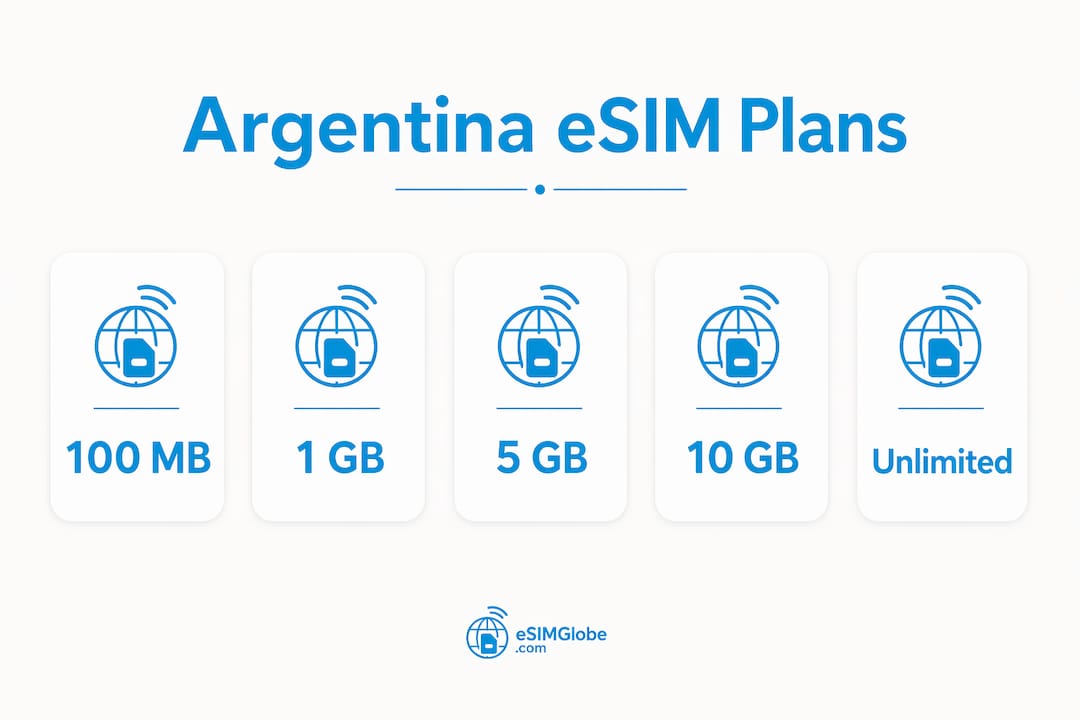
Pricing scales predictably with data volume and duration. The 100 MB plan sits at the entry level, well under $1, while the unlimited daily pass targets travelers who cannot risk running out of data. Most visitors to Argentina find the 3–5 GB range covers a standard two-week trip without stress.
What makes Esimglobe’s pricing competitive?
Instant online purchase and activation via QR code means no airport kiosk lines and no local store visits. You buy the plan before you board, scan the QR code from your email, and your phone connects to an Argentine network the moment you land. That convenience has real value when you factor in the time and uncertainty of finding a local SIM vendor in an unfamiliar city.
Pro Tip: Purchase and install your Esimglobe eSIM at least 24 hours before departure. Installation takes under five minutes, but doing it at home on Wi-Fi removes any risk of activation issues at the airport.
The mid-tier plans offer the strongest value for most travelers. A 5 GB 15-day plan covers a typical two-week trip to Buenos Aires and surrounding regions without requiring constant data monitoring. Travelers combining city time with rural excursions should step up to the 10 GB 30-day plan to account for heavier navigation use outside urban centers.
How does network coverage in Argentina affect eSIM performance?
Argentina spans a vast geographic area, and mobile coverage does not distribute evenly across it. Understanding where each network is strong helps you avoid dead zones on your trip.
-
Buenos Aires and greater metro area. All three major networks, Claro, Personal, and Movistar, provide strong 4G LTE coverage throughout the capital. Signal quality in Buenos Aires is comparable to major European cities.
-
Córdoba and Mendoza. Both cities have reliable 4G coverage from Claro and Personal. Mendoza’s wine regions extend into rural valleys where Claro maintains the strongest signal among the three carriers.
-
Patagonia and southern Argentina. Claro dominates rural coverage in Patagonia, including areas around Bariloche, El Calafate, and Torres del Paine access routes. Movistar coverage drops sharply outside towns. Travelers planning trekking routes or road trips through Patagonia should confirm their eSIM plan runs on Claro or Personal.
-
Northern provinces and remote areas. Regions like Salta, Jujuy, and the northwest wine valleys have growing coverage from Claro and Personal. Signal strength varies by altitude and terrain. A plan with automatic network switching between Claro and Personal provides the most reliable experience in these zones.
-
5G availability. 5G has been rolled out in Buenos Aires and parts of Córdoba but remains limited and inconsistent. Most eSIM travelers default to 4G LTE, which delivers stable speeds for all standard travel use cases including video calls and navigation.
The practical takeaway is straightforward. Urban travelers can use any plan without worrying about network choice. Travelers going beyond the main cities should check coverage for remote areas and select a plan backed by Claro as the primary network.
What practical tips help you get the most from your Argentina eSIM?
Getting connected is only the first step. Managing your data well throughout the trip is what keeps you from running out at a critical moment.
- Activate before arrival. Esimglobe delivers your QR code by email immediately after purchase. Scan it at home on Wi-Fi so your eSIM is ready the moment you land in Buenos Aires.
- Monitor data usage daily. Both iOS and Android have built-in data usage trackers under network settings. Check your consumption every morning to catch unexpected spikes early.
- Turn off background app refresh. Apps like Instagram, Gmail, and news aggregators consume data in the background even when you are not actively using them. Disabling background refresh on non-essential apps can extend a 3 GB plan by a full day or more.
- Use ad-blocking features when available. Local Argentine websites use heavy ad-tech that can consume 200–400 MB per week on its own. eSIM plans with built-in ad blockers reduce that waste automatically, extending the effective life of smaller data packages.
- Switch to lower video quality. YouTube and Netflix default to high resolution on mobile data. Setting video quality to 480p or lower cuts data consumption by more than half during streaming sessions.
- Keep your physical SIM active as a backup. Most modern smartphones support dual SIM operation. Keeping your home SIM active for calls while using your Esimglobe eSIM for data gives you a fallback if data runs low.
Pro Tip: If your phone supports automatic network switching, enable it. Switching between Claro and Personal automatically improves reliability in areas where one carrier has gaps, particularly on road trips through rural Argentina.
Troubleshooting common connectivity issues
If your eSIM stops connecting after arrival, the fix is usually simple. Go to your phone’s cellular settings and confirm the Esimglobe eSIM is set as the active data line. In some cases, toggling airplane mode off and on forces the phone to re-register on the local network. If the issue persists, restarting the device resolves most activation conflicts. Esimglobe’s support team is reachable online if the problem requires account-level assistance.
Key takeaways
Choosing the right Argentina eSIM means matching your plan’s data volume, duration, and network coverage to your specific itinerary.
| Point | Details |
|---|---|
| Match data to your itinerary | Urban trips need 1–5 GB; rural or work trips need 10 GB or more. |
| Prioritize Claro for rural travel | Claro has the strongest coverage outside Buenos Aires and major cities. |
| Buy and activate before departure | Esimglobe delivers QR codes instantly; activate on home Wi-Fi to avoid airport delays. |
| Use ad blockers to save data | Heavy Argentine ad-tech can drain 200–400 MB per week without one. |
| 4G LTE is the reliable standard | 5G exists in Buenos Aires and Córdoba but is not yet consistent enough to depend on. |
My honest take on Argentina eSIM planning
After spending time researching connectivity across Argentina’s wildly different regions, the single biggest mistake I see travelers make is buying a plan based on price alone. A $2 plan with 1 GB sounds great until you realize you are navigating unpaved roads in Patagonia with no signal and a half-used data balance that cannot reach a local tower.
The network question matters more than most travelers expect. Claro’s rural footprint in Argentina is genuinely impressive compared to the other carriers. If your trip includes anything outside the main cities, a Claro-backed plan is not optional. It is the practical choice.
I also think the ad-tech data drain is one of the most underappreciated issues for travelers in Argentina. Local news sites, currency conversion pages, and tourism portals run aggressive auto-refreshing ads. Without an ad blocker, you can burn through 400 MB in a week just loading pages. That is real money on a small plan.
My recommendation is to buy one tier above what you think you need. If you estimate 3 GB, buy 5 GB. The price difference is small, and the peace of mind is worth it. Esimglobe’s plan range makes it easy to step up without a dramatic cost increase. Check the full plan comparison before you decide, and factor in your actual itinerary rather than an optimistic estimate.
— daniele
Plan your Argentina trip with Esimglobe
Esimglobe offers Argentina eSIM plans for every type of traveler, from a 100 MB starter for weekend visitors to unlimited daily passes for remote workers. Plans activate instantly via QR code, with no store visits or physical SIM swaps required. Coverage runs on Argentina’s main networks, including Claro for rural zones and Personal for broader reach.
Pricing starts well under $1 for minimal data and scales to full unlimited options for travelers who need uninterrupted connectivity. Whether you are spending a week in Buenos Aires or three weeks crossing Patagonia, Esimglobe has a plan sized for your trip. Browse the full range of Argentina eSIM plans and activate before you board.
FAQ
What is an eSIM and how does it work in Argentina?
An eSIM is a digital SIM built into your phone that connects to local networks without a physical card. In Argentina, it activates via QR code and connects to carriers like Claro, Personal, or Movistar depending on your plan.
How much does an Argentina eSIM cost?
Argentina eSIM plans start at about $0.92 for small data packages. Mid-tier 5–10 GB plans for 15 days typically cost $4–$16, with larger 30-day packages going above $50.
Which network is best for traveling outside Buenos Aires?
Claro provides the strongest coverage in rural Argentina, including Patagonia and the Mendoza wine regions. Movistar and Personal are reliable in cities but weaker in remote areas.
How do I activate my Esimglobe eSIM for Argentina?
Esimglobe sends a QR code to your email immediately after purchase. Scan the code in your phone’s cellular settings, and your eSIM activates. The process takes under five minutes and works best on a Wi-Fi connection before you travel.
Is 5G available in Argentina for eSIM users?
5G is available in Buenos Aires and parts of Córdoba but remains limited. Most travelers use 4G LTE, which delivers reliable speeds for navigation, messaging, and video calls throughout the country.