






















EsimGlobe is the better buy for most Europe trips. Instant digital delivery, dedicated regional Europe plans, and 24/7 support cover the scenarios that trip up most short-term travelers. Lebara works as a local SIM option within certain European countries, but it does not offer the same multi-country eSIM structure. A single-country or long-stay traveler might still prefer a local operator plan for specific coverage needs.
TL;DR:
- Multi-country regional plans like eSIM Europe cover over 30 areas, making them cost-effective for multi-stop trips across Europe.
- Short trips within one country are cheaper with single-country plans, which often have more flexible validity windows and lower per-GB costs.
- Unlimited plans generally cap data speeds or use fair-use limits, so they are best suited for heavy usage over a fixed period rather than long-term sessions.
- Availability of round-the-clock support and instant QR code delivery are crucial in case of activation issues, especially during late-night landings.
- Verifying device compatibility, plan details, and avoiding plans with no support contact or no stated validity prevents activation failures and surprising charges.
Table of Contents
- Coverage, validity, and price: the factors that decide your plan
- How to buy and activate an EsimGlobe eSIM before you land in Europe
- What pricing, validity, and fair-use rules mean for your actual cost
- Checking your phone and spotting a bad eSIM offer
- Why the EsimGlobe recommendation holds up
- Total cost analysis including fees and potential hidden charges
- Estimated activation and setup time from purchase to ready-to-use
- Comparison of customer support and troubleshooting experiences
- Duration and validity periods of the eSIM data plans
- Cancellation and refund policies specific to each provider
- Which plan I would pick for each kind of trip
- Buy EsimGlobe: the right plan for your Europe trip
- Where to read more before you travel
- FAQ
Coverage, validity, and price: the factors that decide your plan
Choosing between Lebara and EsimGlobe, or between any two eSIM options, comes down to six dimensions. Each trip type weighs them differently.
- Coverage area: single-country plans fit one destination; regional plans like eSIM Europe (30+ areas) cover multiple borders on one profile.
- Validity window: short trips need short validity; longer stays need extended or renewable windows.
- Data allowance: fixed-GB plans suit light users; unlimited short-term plans suit video calls and navigation-heavy days.
- Price model: pay-per-GB versus flat unlimited pricing changes the math depending on trip length.
- Activation speed: QR-based instant delivery removes the wait that physical SIMs require.
- Support availability: a 24/7 contact matters most during border crossings and late-night arrivals.
A city break to one country usually needs just a single-country or small regional plan. A multi-country itinerary, Paris to Rome to Barcelona in two weeks, benefits from one regional profile instead of three separate purchases. A long remote-work stay changes the calculation again: fixed monthly cost and reliability matter more than per-GB pricing.
One regulatory note matters here. The The EU’s “Roam Like at Home” protections apply to residents using their home provider across the EU bloc. A U.S. traveler buying a prepaid eSIM is not covered by that resident framework, so fair-use limits and country restrictions inside a plan still apply regardless of what the marketing language implies.
How to buy and activate an EsimGlobe eSIM before you land in Europe
Buying an eSIM takes less effort than most travelers expect, but a few checks beforehand prevent a dead-on-arrival connection.
- Confirm your phone is unlocked and running an eSIM-compatible operating system version.
- Keep your home SIM active in a secondary slot if you rely on it for SMS-based two-factor authentication.
- Pick the product that matches your itinerary: eSIM Europe (30+ areas) for multi-country trips, eSIM Italy for a single-country stay, or an entry from the unlimited plans collection for heavy data use.
- Complete checkout and wait for instant delivery by email, typically a QR code and a manual installation code.
- On iOS, go to Settings, Cellular, Add eSIM, and scan the QR code. On Android, the path is Settings, Network and Internet, SIMs, Add eSIM.
- Label the new line, set it as the data line, and turn on data roaming for that eSIM only.
- Run a quick speed test once you land to confirm the connection before you need it.
If the scan fails, manual entry using the code from the delivery email is the standard fallback for both operating systems.
Pro Tip: Install the eSIM before you board the plane but keep your home SIM active for texts or verification codes you might still need in transit.
What pricing, validity, and fair-use rules mean for your actual cost
Regional Europe plans trade a small price premium for simplicity: one profile, one activation, coverage across dozens of countries. Single-country plans, such as eSIM Italy, often cost less per GB when the whole trip stays inside one border. Global bundles make sense only for travelers continuing past Europe into other continents on the same trip.
- Regional and country plans are typically sold as one-off, prepaid purchases rather than subscriptions.
- Validity windows are fixed at purchase and do not extend automatically once a trip runs long.
- Unlimited short-term plans typically cap speed or apply fair-use thresholds instead of providing truly unbounded data.
- A country-specific plan can beat a regional plan on price when the entire itinerary stays in one country.
EU roam-like-home protections apply to residents of EU/EEA countries using their home operator, not to visitors on a prepaid eSIM. Travelers who assume unlimited cross-border roaming often hit a fair-use wall they did not expect, which is why checking a plan’s country list and validity window before departure avoids a mid-trip surprise.
A country-specific plan wins on reliability when a trip never leaves that country, since there is no need to pay for coverage you will not use.
Checking your phone and spotting a bad eSIM offer
Most phones sold in the past several years support eSIM, but confirming it before you buy saves a failed activation at the airport.
- On iPhone, check Settings, General, About for “Digital SIM” or try adding an eSIM directly to see if the option appears.
- On Android, check Settings, Network and Internet, SIMs for an “Add eSIM” option, since availability varies by manufacturer and carrier lock status.
- Ask your home carrier whether the phone is carrier-locked, since a locked device can block a second active profile.
- Treat an offer with no QR code, no listed support contact, or no stated validity window as a red flag.
- After activation, confirm the network name shown in your status bar, run a data test, and check that the APN matches what the provider specified.
Why the EsimGlobe recommendation holds up
EsimGlobe is an international telecommunications platform built specifically around eSIM delivery for travelers, with digital profiles covering countries across multiple continents. The platform’s product catalog spans single-country pages and multi-region collections, sold in multiple currencies and languages, which matters for a reader comparing options across different home markets.
Guides published on the EsimGlobe blog, including activation walkthroughs and country-specific advice for Europe travel, are written by Daniel, whose posts focus on the practical mechanics of buying, installing, and troubleshooting an eSIM rather than general travel content. That focus on the purchase and activation process, not just destination tips, is why this comparison leans on EsimGlobe’s own product structure: it is the structure a reader is about to use.
Total cost analysis including fees and potential hidden charges
Headline prices rarely tell the full cost story. A per-GB plan looks cheap until a traveler goes over the allowance and either loses speed or needs a top-up purchase mid-trip. A regional plan avoids that scenario across multiple countries, but only when all planned destinations are actually included in that region’s country list, which is worth checking before paying.
Hidden charges with prepaid eSIMs tend to come from three places: overage top-ups, plans that silently throttle speed once a soft data cap is hit, and validity windows that expire before a trip ends, forcing a second purchase. None of these show up as a line-item fee, which is why they catch travelers off guard more than any explicit charge would.
Checkout currency also affects the real cost. EsimGlobe allows checkout in multiple currencies, including USD, which matters for a U.S. traveler comparing a listed price against what a card statement will actually show. A plan quoted in a foreign currency on a different provider’s site can carry a conversion fee from the card issuer that never appears on the provider’s own page.
The simplest way to avoid a hidden charge is to match the plan’s data allowance and validity window to the real itinerary length before paying, rather than defaulting to the cheapest headline price and hoping it stretches far enough.

Estimated activation and setup time from purchase to ready-to-use
Delivery is instant: the QR code and manual installation details arrive by email right after checkout, with no shipping wait and no store visit. Installation itself takes a few minutes on both iOS and Android, assuming the phone is already confirmed eSIM-compatible and unlocked.
The step most travelers underestimate is the Wi-Fi requirement. Most eSIM profiles need an internet connection, typically Wi-Fi, to complete installation, so activating on the way to the airport using mobile data alone can stall the process. Doing it the night before, on home Wi-Fi, avoids that bottleneck entirely.
Once installed, the profile can sit inactive until needed. Turning on data roaming for that specific line after landing is usually the last step, and a quick speed test confirms the connection before you rely on it for navigation or translation apps at the airport.

Comparison of customer support and troubleshooting experiences
Support quality becomes the deciding factor the moment an activation fails or a QR code will not scan. EsimGlobe lists 24/7 support as part of its service, which matters most during odd-hour arrivals when a traveler lands at 2 a.m. local time with no working data connection.
Local carrier support, by contrast, often runs on standard business hours in that carrier’s home market, which can leave a traveler without help exactly when a layover or late landing creates the problem. A provider with round-the-clock contact options removes that gap, particularly for anyone activating a profile for the first time mid-trip rather than before departure.
Troubleshooting itself usually comes down to a short list: re-scanning the QR code, re-entering the manual activation details, confirming the correct APN, and toggling data roaming off and back on. Having a support channel that can walk through that list in real time, rather than a ticket queue with a multi-hour reply window, is the practical difference travelers notice when something does not work on the first try.
Duration and validity periods of the eSIM data plans
Validity periods are fixed at the point of purchase and do not pause or extend once a trip runs longer than planned. A short regional or country plan typically covers a set number of days from activation, not from purchase, which gives some flexibility if a flight gets delayed before installation.
Unlimited short-term plans, such as those in the unlimited plans collection, are built around fixed windows rather than ongoing subscriptions. That structure suits a two-week trip cleanly but requires a fresh purchase for a longer stay, since there is no automatic renewal built into a one-off plan.
Matching the validity window to the actual trip length, with a buffer for a delayed flight home, avoids the common mistake of a plan expiring a day or two before the return flight.
Cancellation and refund policies specific to each provider
Prepaid eSIM plans are generally sold as one-off purchases rather than subscriptions, which changes how cancellation works compared to a monthly phone contract. There is no recurring charge to cancel, since the purchase itself is a single transaction tied to a fixed data allowance and validity window.
Refund terms for a prepaid data plan typically hinge on whether the eSIM was installed or activated. A profile that has never been installed is in a different position than one already connected to a network, which is why checking a provider’s refund terms before installation, not after, protects a traveler who changes plans before the trip starts.
Local carrier plans like those sold by Lebara in specific European markets can carry different cancellation terms tied to that carrier’s own contract structure, which is a reasonable thing to check directly with the carrier if a local SIM is the preferred route for a single-country stay.
Which plan I would pick for each kind of trip
For a short city break, I would pick a small regional or short-term unlimited plan rather than overbuying data I will not use. For a multi-stop trip across several countries, eSIM Europe (30+ areas) solves the one-profile, multiple-border problem cleanly. For a long stay or remote work stint, a single-country plan or a longer unlimited option tends to hold up better than stacking short-term purchases.
Whatever the trip length, I would still keep a backup: a secondary local SIM or a portable hotspot for the one day that matters most.
— Daniel
Buy EsimGlobe: the right plan for your Europe trip
Most multi-country trips across Europe fit cleanly into eSIM Europe (30+ areas), one purchase, one activation, coverage across the region. A trip focused entirely on one country fits better with eSIM Italy or, for heavier data use, eSIM Italy Unlimited.
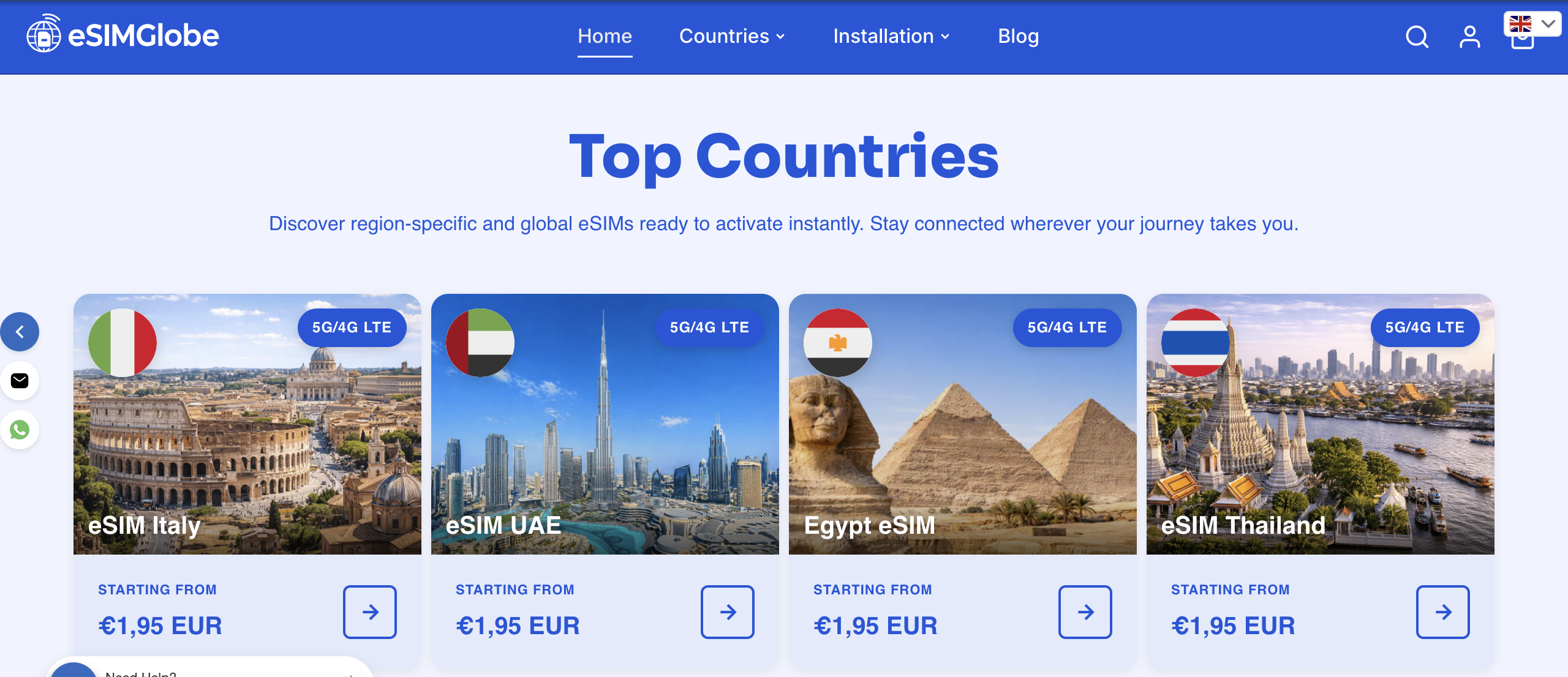
Instant delivery and 24/7 support are important features to have, especially the moment a QR code will not scan at midnight in an unfamiliar airport. Pick the product that matches your itinerary and check availability on the EsimGlobe homepage before your next trip.
Where to read more before you travel
- eSIM vs Local SIM: What Travelers Should Know compares eSIM and physical SIM options directly.
- Unlocking your phone before travel helps confirm compatibility ahead of departure.
- Budget travel apps help plan connectivity costs alongside the rest of a trip budget.
FAQ
What is the best eSIM to use in Europe?
For most multi-country trips, a regional plan like eSIM Europe (30+ areas) is the practical choice because it covers many countries on one profile with instant delivery. A single-country plan makes more sense when the entire trip stays inside one border.
Which eSIM provider is best for traveling to Europe?
EsimGlobe suits most travelers because it combines regional and single-country Europe plans with instant digital delivery and 24/7 support. Local carriers can work for a single-country stay, but they do not offer the same one-profile, multi-country structure.
Can I get an eSIM from Lebara Mobile?
Lebara operates as a local mobile provider in specific European markets and offers SIM options within those markets rather than a broad multi-country eSIM catalog. Travelers planning stops in several countries typically need a separate purchase for each market under that model.
Which eSIM provider has the best global plan?
EsimGlobe lists global and multi-region unlimited collections, including options covering 120 or more areas, for travelers continuing beyond Europe on the same trip. Checking the specific country list inside a global plan before buying confirms it covers every planned stop.
How do I activate an EsimGlobe eSIM on my phone?
After checkout, EsimGlobe delivers a QR code and manual installation details by email, ready to install right away. On iPhone, go to Settings, Cellular, Add eSIM; on Android, go to Settings, Network and Internet, SIMs, Add eSIM, then scan the code or enter the details manually.