






















For most international travelers, the best prepaid eSIM setup pairs a global plan for baseline coverage with a country-specific plan for your main destination. Heavy data users and digital nomads on longer trips should look at unlimited duration plans like EsimGlobe’s eSIM Global (120+ areas) Unlimited, while short-trip travelers heading to one country get better value from a fixed-country plan like eSIM Seoul or eSIM Bermuda. The reason comes down to three things: real coverage across the areas you’re actually visiting, instant email delivery so you’re online before you land, and a prepaid checkout with no contract to cancel later.
TL;DR:
- Global plans with unlimited data hours are ideal for long trips with heavy streaming and hotspot needs, lasting 7 to 30 days depending on the provider.
- Country-specific eSIMs tend to be more cost-effective for single-destination trips, especially to underserved regions like Sierra Leone, Bermuda, or Réunion.
- Per-GB plans are suited for light use or short trips, but travelers should monitor their data to avoid throttling or cutouts once limits are reached.
- Confirming device compatibility, understanding support services, and testing the eSIM early are crucial steps before relying on it abroad.
- Accuracy in coverage maps, data caps, hotspot policies, and activation windows are key factors to pick the right plan, with the safest approach testing for a few days upfront.
Table of Contents
- What Are the Best Prepaid eSIM Options for Travelers?
- What Types of Prepaid eSIM Plans Exist?
- How Do You Choose the Right Prepaid eSIM Plan?
- How Do You Activate an eSIM and Check Device Compatibility?
- How Fast Are Prepaid eSIM Plans, and Do They Throttle Data?
- How Long Do Prepaid eSIM Plans Last?
- How Do Prepaid eSIM Providers Compare on Support and Reliability?
- Where Can You Buy a Prepaid eSIM Plan?
- Is a Prepaid eSIM Safe and Private to Use?
- What Can’t You Do on a Prepaid eSIM Plan?
- What I’ve Learned Comparing Prepaid eSIM Plans Across Trips
- Sources and Product Pages for Further Reading
- Get Connected Before You Land With EsimGlobe
- FAQ
What Are the Best Prepaid eSIM Options for Travelers?
Picking the right plan starts with matching your trip shape to a product built for it. A three-country backpacking route needs different coverage than a six-month remote work stint in one city, and the plans below map to those different jobs.
eSIM Global (130+ areas) covers the widest footprint on this list, spanning more than 130 countries and regions on a single profile. It’s the pick for multi-country itineraries where you don’t want to juggle separate eSIMs for each border crossing. Pricing runs on a per-GB structure, so you pay for a data bucket rather than an unlimited daily allowance, which keeps costs predictable for trip planning. Get it on the eSIM Global (130+ areas) page.
eSIM Global (120+ areas) Unlimited is built for the opposite instinct: stop counting gigabytes entirely. This is the plan for digital nomads who stream, video call, and hotspot a laptop daily across a long-haul trip. Instead of per-GB pricing, you’re paying for a duration window with unlimited high-speed data inside it, which removes the anxiety of watching a data meter during a work sprint. Find current duration options on the eSIM Global (120+ areas) Unlimited page.
eSIM Global (120+ areas) sits between the two above: broad country coverage without the unlimited price tag, aimed at travelers who want flexibility across regions but don’t need to hotspot all day. It’s a sensible default for someone visiting three or four countries on one trip without heavy streaming needs. Check current plan sizes on the eSIM Global (120+ areas) page.
eSIM Seoul is a country-specific plan for travelers whose trip is anchored to South Korea. Single-country plans like this typically undercut regional or global pricing per gigabyte, because you’re not paying for coverage you won’t use. It suits a business trip, a conference visit, or a vacation confined to one country. See it on the eSIM Seoul page.
eSIM Sierra Leone fills a coverage gap that many global eSIM providers skip outright. West Africa remains underserved by broad regional bundles, so a dedicated country plan matters more here than in, say, Western Europe. Travelers, NGO staff, and business visitors headed to Sierra Leone get a direct plan rather than hunting for a regional bundle that may not actually include the country. Details are on the eSIM Sierra Leone page.
eSIM El Salvador serves a similar purpose for Central America. If your trip is a single-country visit rather than a regional tour, a country-specific plan avoids paying for a broader bundle you’ll only use in one place. Find it on the eSIM El Salvador page.
eSIM Bermuda covers a common blind spot: island destinations that some multi-country bundles quietly exclude. Short trips to Bermuda, whether for a wedding, a cruise stopover, or a long weekend, don’t justify a global plan. A country-specific option here keeps the price proportional to the trip length. Check availability on the eSIM Bermuda page.
eSIM Reunion Unlimited rounds out the list for travelers heading to Réunion who want the same unlimited-data logic as the global plan, but scoped to one destination. It fits vacationers who plan to stream or navigate heavily during a single-island stay without buying broader regional data they won’t touch. See plan lengths on the eSIM Reunion Unlimited page.
The pattern across all eight: match the plan’s geographic scope to your actual itinerary, and match the pricing structure (per-GB versus unlimited duration) to how heavily you’ll actually use data day to day.
What Types of Prepaid eSIM Plans Exist?
Every prepaid eSIM on the market falls into one of three structures, and understanding which one you’re buying prevents the most common buyer’s regret: running out of data on day four of a ten-day trip.
- Per-GB plans. You buy a fixed data allowance, say 5GB or 10GB, valid for a set window, often 15 or 30 days. These tend to be the cheapest option for light users: checking email, maps, messaging apps, and the occasional browsing session. The trade-off is a hard ceiling. Once you hit your GB limit, speeds usually drop to a crawl or data stops entirely until you top up.
- Duration-based unlimited plans. Instead of metering data, these charge for a block of time, often 7, 15, or 30 days, with unlimited (or “unlimited at high speed up to a threshold”) data inside that window. Reviews of these plans consistently point to them being the better fit for heavy hotspotters and digital nomads who stream video calls, back up photos, or tether a laptop for work. The cost per day tends to run higher than per-GB plans, but you never watch a data counter.
- Pay-as-you-go / global multi-region profiles. These are broader eSIM profiles, like EsimGlobe’s Global plans, that work across dozens or over a hundred countries on one purchase. They suit multi-stop trips where buying a separate eSIM per border would be impractical. Validity windows and data caps vary by the specific plan, so check the product page details before assuming “global” means unlimited.
The real trade-off isn’t just price. Per-GB plans give you cost predictability but throttling risk if you underestimate usage. Unlimited duration plans remove that risk but cost more for someone who was only going to use 2GB anyway. Multi-region profiles win on convenience but sometimes cost more per gigabyte than a country-specific plan would for a single-destination trip. A prepaid eSIM guide can help you see how these structures compare side by side before you commit.
Pro Tip: Buy a short, low-cost plan for your first two or three days in a new country before committing to a longer or larger plan. It’s the fastest way to confirm actual network performance in the specific city or region you’re visiting, rather than trusting a coverage map alone.
One more practical note: hotspot and tethering limits vary even within the same plan family. Some unlimited plans throttle hotspot data separately from on-device data, so if your whole trip depends on tethering a laptop, confirm that detail before buying rather than after you land.
How Do You Choose the Right Prepaid eSIM Plan?
Choosing well comes down to running a short checklist against any product page before you pay, not comparing marketing taglines.
- Coverage map. Confirm your actual destination country or countries are listed, not just the region name. “Europe” bundles sometimes exclude specific countries.
- High-speed data cap. Know exactly how many GB you get at full speed and what happens after: throttled speed, blocked access, or automatic top-up.
- Hotspot policy. Some plans allow full-speed tethering, others cap hotspot data separately or block it outright. Check this explicitly if you’re working remotely.
- APN and support access. Confirm the provider offers setup instructions and a support channel you can reach from abroad, ideally 24/7 chat or email.
- Refund and compatibility policy. Know the provider’s rules before you buy, especially if your phone’s eSIM compatibility is uncertain.
- Activation window. Many eSIMs must be activated within a set number of days of purchase or first network connection. Know that deadline before you travel.
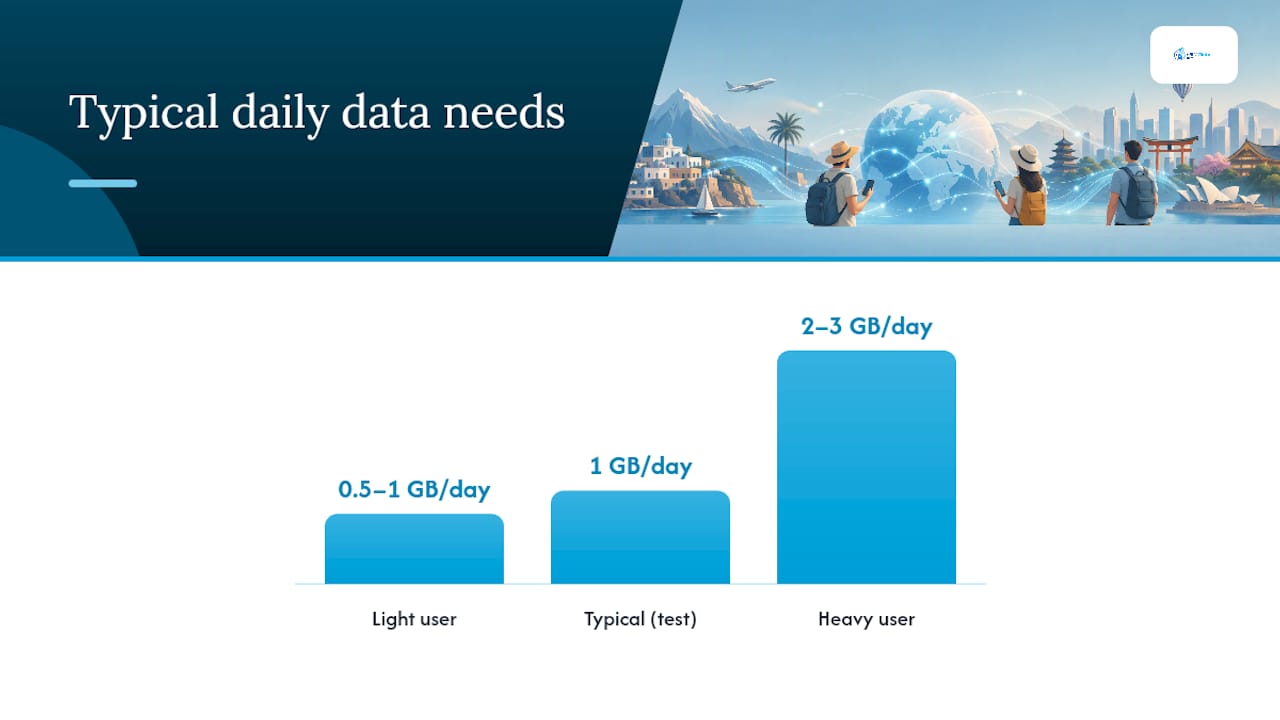
Estimating your real data need is simpler than it sounds. Take a typical day at home: how much data does your phone use for maps, messaging, social media, and email? Most light users land around 0.5 to 1GB per day; heavy users who stream video or navigate constantly can hit 2 to 3GB per day. A ten-day trip at 1GB per day means a 10 to 12GB plan is more sensible than either a 3GB budget plan or an expensive unlimited one you won’t fully use.
Red flags worth watching for: a product page with no listed data cap or “unlimited” language that isn’t paired with a fair-use or high-speed threshold, no visible support contact, and no clear activation instructions. Comparison directories that index large eSIM catalogs consistently point to cost per GB, validity window, and country coverage as the three filters that matter most when sorting through options. When you’re genuinely unsure which plan fits, the simplest rule is to buy the shortest, cheapest plan available and test it before committing to anything larger. It costs a few dollars and removes almost all the guesswork.
How Do You Activate an eSIM and Check Device Compatibility?
Before buying anything, confirm your phone supports eSIM at all. Most iPhones from the XS generation onward support eSIM, as do most Pixel phones from the Pixel 3 onward and many recent Samsung Galaxy models. Older or budget Android phones frequently lack eSIM hardware entirely, and carrier-locked phones (common with certain US carrier contracts) may block third-party eSIM installation even on supported hardware. Check your phone’s settings menu for an existing “Add eSIM” or “Add Cellular Plan” option as the fastest compatibility test.
Activation itself follows a short, repeatable sequence:
- Buy the plan and receive the eSIM by email, typically as a QR code, within minutes of checkout.
- Open your phone’s cellular or mobile data settings and select “Add eSIM” or “Add Cellular Plan.”
- Scan the QR code from the confirmation email, or enter the activation details manually if scanning isn’t available.
- Select the new eSIM profile as your data line and enable data roaming for that profile.
- Confirm you have a data connection before you need it, ideally while still on home Wi-Fi.
If the profile doesn’t connect right away, the most common fixes are toggling airplane mode on and off, manually setting the APN from the provider’s instructions, or restarting the phone once the profile is installed.
Pro Tip: Install and test your eSIM before you leave, while you still have Wi-Fi and time to contact support if something goes wrong. Landing at a foreign airport with a broken data profile and no way to reach customer service is the worst time to troubleshoot.
How Fast Are Prepaid eSIM Plans, and Do They Throttle Data?
Speed depends far more on the local network your eSIM rides on than on the eSIM itself. Most prepaid eSIMs connect to the same 4G LTE or 5G towers a local SIM would use, so a plan advertising “5G” in a country with limited 5G rollout still performs at whatever the local network delivers.
Throttling is where plans genuinely differ. Per-GB plans usually throttle hard once you exhaust your allotted data, dropping to speeds too slow for anything beyond basic messaging. Duration-based unlimited plans typically offer full-speed data up to a daily or total threshold, then throttle to a reduced but still usable speed rather than cutting you off completely, though the exact threshold varies by plan and is worth checking on the product page.
Hotspot and tethering capability is the detail travelers most often overlook. Tethering a laptop or second device usually draws from the same data pool as your phone, but some providers cap hotspot usage separately or disable it on certain plans entirely. If your trip depends on tethering, for remote work, sharing with a travel companion, or connecting a tablet, verify hotspot support explicitly rather than assuming it’s included just because the plan advertises unlimited data.
How Long Do Prepaid eSIM Plans Last?
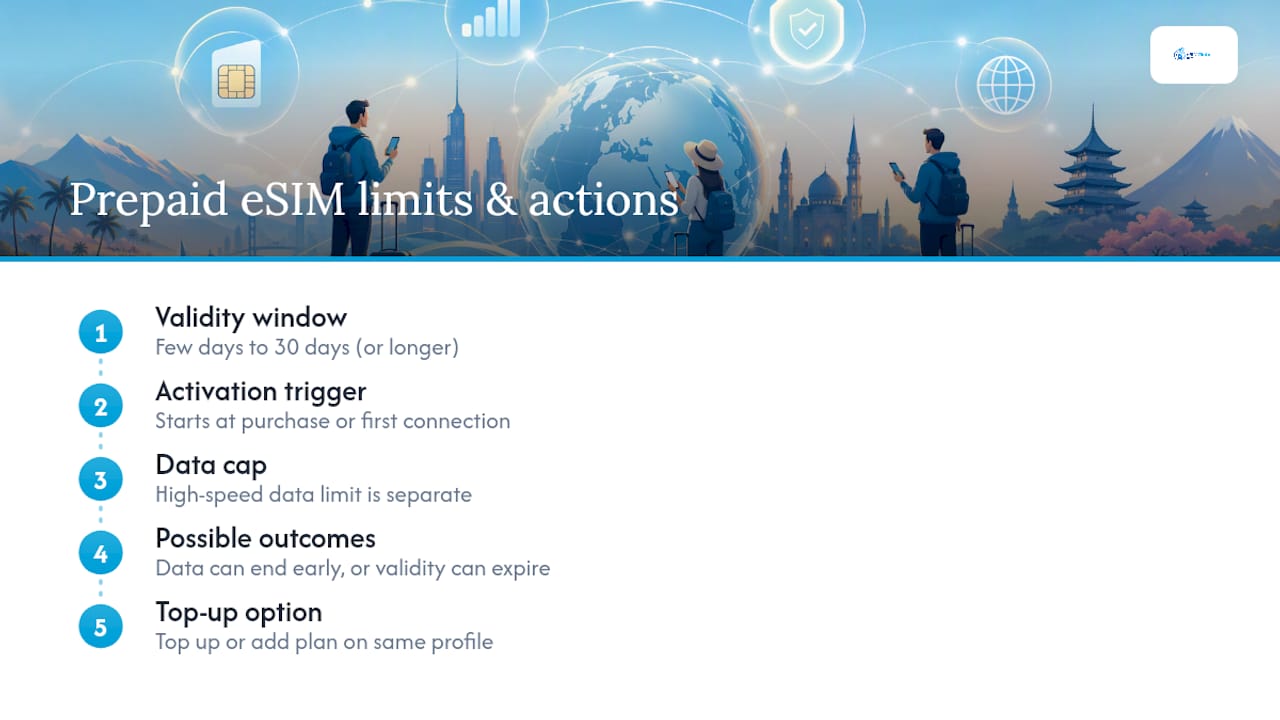
Validity windows are set per plan and typically range from a few days for short trips to 30 days for longer stays, with some global and unlimited plans offering extended windows for long-term travelers. The clock usually starts either at the moment of purchase or the moment the eSIM first connects to a network, so check which trigger applies before you buy, especially if you’re purchasing in advance of your trip.
Running low on data mid-trip doesn’t mean starting over. Most prepaid eSIM providers, including EsimGlobe, let you top up an existing plan or purchase an additional plan on the same profile rather than reinstalling a new eSIM from scratch. This matters for trip planning: if you’re unsure whether 10 days or 15 days is the right validity window, buying the shorter option and topping up if needed is usually cheaper than overbuying validity you might not use.
One practical wrinkle: a plan’s validity window and its data cap are two separate limits. You can run out of high-speed data on day 5 of a 15-day validity window, or you can still have data left when the validity window closes and access simply ends. Read both numbers on the product page, not just one.
How Do Prepaid eSIM Providers Compare on Support and Reliability?
The eSIM market is fragmented, with large comparison directories now indexing hundreds of thousands of individual prepaid plans across dozens of providers. That volume makes side-by-side comparison shopping genuinely difficult, and it’s part of why a provider offering multi-region coverage under one consistent brand, like EsimGlobe’s Global plans, reduces the friction of researching a new provider for every country on a multi-stop trip.
Reliability comes down to two things travelers actually notice: network partner quality in the destination country, and how fast support responds when something breaks. A plan is only as good as the local network it rides on, so coverage maps matter more than brand name. Support responsiveness matters just as much, particularly for travelers who activate a plan only to discover an APN issue or a profile that won’t install. EsimGlobe offers 24/7 support alongside its instant email delivery, which matters most in the exact moment a traveler needs it: after landing, with limited time and no local SIM card as a backup.
Rather than betting on a single small regional provider for each leg of a trip, many travelers consolidate onto one provider with broad country support and consistent support quality across all of it.
Where Can You Buy a Prepaid eSIM Plan?
Prepaid eSIMs are sold directly through provider websites, through dedicated eSIM comparison and management apps on the Apple App Store and Google Play, and occasionally through third-party marketplace apps that resell multiple providers’ plans in one interface.
Buying directly from a provider’s website, such as EsimGlobe’s own product pages, is generally the most straightforward path: you select your destination, choose a plan size or duration, pay through a standard checkout, and receive your QR code by email within minutes. App-based purchases work similarly but add an extra install step before you even reach checkout.
Authorized reseller apps can be useful for comparing multiple providers’ pricing in one place, but they add a layer between you and the provider that can complicate refunds or support requests if something goes wrong. For most travelers, buying directly from the provider whose plan you’ve already decided on, after comparing coverage and price on a couple of product pages, is the simpler and more reliable route.
Is a Prepaid eSIM Safe and Private to Use?
Prepaid eSIMs are generally more secure than relying on public Wi-Fi networks for sensitive activity like banking or logging into work accounts, since a cellular data connection through a licensed carrier partner isn’t shared with strangers on the same network the way open Wi-Fi is. That said, an eSIM is still a data connection, not a security tool on its own, so standard precautions still apply: use a VPN for sensitive browsing if that’s part of your normal routine, and keep your device’s software updated.
Buying from a provider with telecom-grade checkout security and a legitimate business presence matters more than most travelers realize. Prepaid eSIMs are typically delivered by email as a QR code, so an insecure checkout process could expose your payment details or your activation code to interception. Look for standard indicators of a secure checkout: HTTPS on the payment page, clear company information, and a support channel you can actually reach, not just a contact form that goes nowhere.
One privacy note specific to prepaid eSIMs: because most plans are data-only and don’t require the identity verification a physical local SIM card sometimes does in certain countries, they can actually offer more privacy for short-term travelers than registering a local SIM under your passport details.
What Can’t You Do on a Prepaid eSIM Plan?
Most prepaid eSIM plans are data-only, which means no traditional voice calling or SMS text messaging through the eSIM’s own phone number, since most prepaid plans don’t assign one. Travelers handle calls and texts through apps like WhatsApp, FaceTime, or other VoIP services running over the data connection instead, which works fine as long as you have signal.
VoIP itself is worth a specific callout: some countries restrict or block VoIP calling over local networks for regulatory reasons, regardless of which eSIM or data plan you’re using. That’s a local network restriction, not something a specific eSIM plan controls, so no prepaid eSIM provider can promise VoIP will work everywhere.
Other common limitations include hotspot caps that differ from the main data allowance, high-speed data thresholds after which speeds drop, and validity windows that don’t pause once started, meaning a 15-day plan burns down whether you’re actively using it or not. None of these are unique to any single provider. They’re structural to how prepaid, data-only eSIMs work across the industry, which is exactly why reading the specific terms on a product page before buying matters more than trusting a plan name like “unlimited” at face value.
What I’ve Learned Comparing Prepaid eSIM Plans Across Trips
A three-week trip through multiple countries is where a global plan earns its price. One scenario that comes up constantly in traveler feedback: someone buys separate country SIMs for a five-country tour, only to lose hours at each border hunting for a kiosk or store that sells local data. A single multi-region eSIM, installed before departure, removes that entire problem, which is exactly the case for something like EsimGlobe’s Global (130+ areas) plan over piecing together country-by-country coverage.
A different pattern shows up with digital nomads working from one city for a month or more. Watching a data meter while running video calls all day is its own kind of stress, and that’s where an unlimited duration plan solves a problem a per-GB plan simply can’t. Business travelers juggling calls, email, and hotel bookings face a related version of this, and pairing solid connectivity with a bit of trip meal planning tends to make the whole trip run smoother, not just the data side of it.
The lesson that holds across every scenario: test the plan for a day or two before trusting it for your whole trip, and always confirm device compatibility before you buy, not after you land with no backup option.
— daniele
Sources and Product Pages for Further Reading
- Best eSIM for traveling: the international traveler’s guide covers broader plan selection strategy for global trips.
- eSIM travel tips: stay connected abroad expands on cost-saving tactics referenced in the pricing section.
- Best international eSIM types for travel breaks down plan structures in more detail.
- Product pages for eSIM Global (130+ areas), eSIM Global (120+ areas) Unlimited, eSIM Seoul, eSIM Sierra Leone, eSIM El Salvador, eSIM Bermuda, and eSIM Reunion Unlimited are linked throughout this guide for direct purchase.
Get Connected Before You Land With EsimGlobe
Piecing together local SIM cards at every airport kiosk costs time you don’t have and often means overpaying for coverage you’ll use for three days. EsimGlobe solves that specific problem: one checkout, instant email delivery, and a plan that matches your actual itinerary instead of whatever the nearest kiosk happens to sell.
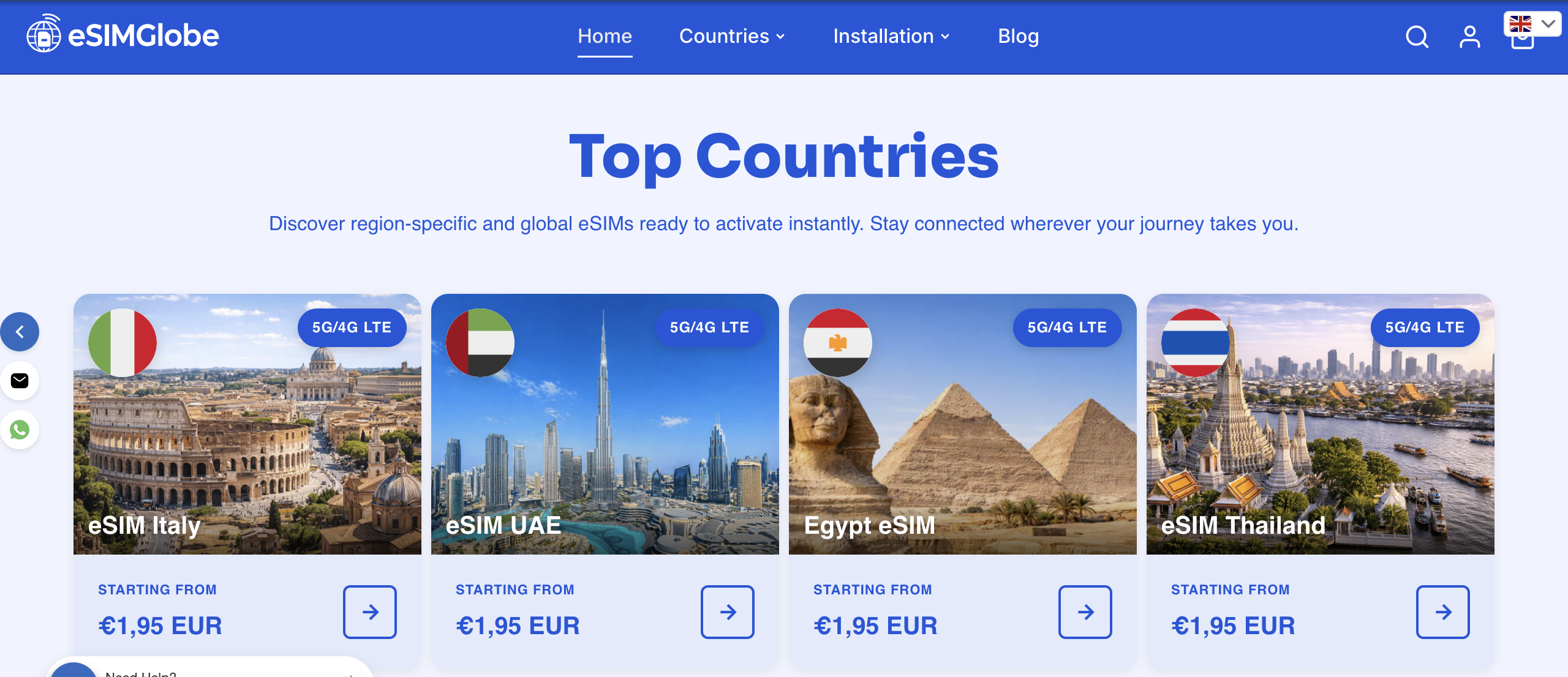
Every product on this list, from the wide-reaching eSIM Global (130+ areas) to single-country options like eSIM Dubai and eSIM GCC, comes with multi-currency checkout, 24/7 support, and telecom-grade security on the payment process. If you’re weighing GCC-region travel specifically, the eSIM GCC Unlimited plan removes the data-counting problem entirely for a Gulf-region trip with heavy daily use. First-time buyers can also check the EsimGlobe promo code page for current checkout discounts before completing a purchase.
Ready to buy? Head to the eSIM Global (120+ areas) Unlimited page if your trip involves heavy daily data use across multiple countries, or search EsimGlobe’s country selector for your specific destination and complete checkout in a few minutes.
FAQ
What Are the Top-Rated Prepaid eSIM Plans?
Top-rated plans typically combine broad country coverage, clear data caps, and fast support response. EsimGlobe’s Global (130+ areas) and Global (120+ areas) Unlimited plans rank highly for multi-country trips and heavy data users respectively.
Is There a Better Prepaid eSIM Than the Big Global Names?
“Better” depends on your trip: a single global provider often beats piecing together multiple smaller ones because it reduces setup friction and support headaches across a multi-country itinerary. EsimGlobe’s country-specific and multi-region catalog is built around that same logic, matching plan scope to actual trip needs rather than one-size-fits-all pricing.
Can You Get a Prepaid eSIM Plan Without a Contract?
Yes. Prepaid eSIM plans are pay-once, no-subscription purchases by design. You select a plan, pay at checkout, and the connectivity ends when the data or validity window runs out, with no automatic renewal or contract to cancel.
What Is the Highest-Rated eSIM for Heavy Data Use?
Unlimited duration plans consistently rate highest among heavy data users and digital nomads because they remove the risk of hitting a data cap mid-trip. EsimGlobe’s Global (120+ areas) Unlimited plan is built specifically for that use case, offering unlimited high-speed data across a set duration window.