






















The best eSIM for Peru for most tourists is Esimglobe’s Peru eSIM, activated before departure and switched on the moment you land in Lima or Cusco. It delivers instantly by email, runs on Peru’s strongest network infrastructure, and prices out cheaper per gigabyte than most airport SIM counters. If you’re ready to buy now, skip to the setup checklist below. If you want the reasoning first, keep reading.
TL;DR:
- The most suitable eSIM for Peru depends on trip length and usage, with fixed data plans for short visits and global unlimited plans for heavy streaming or extended trips.
- Coverage varies by region, with Claro offering the strongest rural and remote signal, but an eSIM that switches between carriers can improve connectivity on the Inca Trail and Andes passes.
- Most travelers should choose fixed-data plans under 20 GB for trips shorter than two weeks, reserving unlimited options for remote work or heavy media use.
- Download and activate the eSIM before departure to avoid connection issues at the airport, and ensure your device is unlocked and eSIM-compatible.
- Pricing generally ranges between a few dollars for small plans and up to $50 for larger data packages, with cost-per-GB decreasing as data allowance increases.
Table of Contents
- What Makes the Best eSIM for Peru?
- How Much Mobile Data Do You Actually Need in Peru?
- Unlimited vs. Fixed Data Plans: How to Choose
- Which Networks Cover Peru Best?
- How to Get an eSIM for Peru: Step-by-Step
- What Does a Peru eSIM Cost in 2026?
- Why Trust This Peru eSIM Recommendation?
- My Take: What I’d Actually Tell a Friend Going to Peru
- Get Your Peru eSIM Before You Land
- Further Reading and Data Sources
- FAQ
What Makes the Best eSIM for Peru?
A good Peru eSIM comes down to three things: does it reach the network with the widest rural footprint, does it arrive fast enough to matter, and does the pricing match how much data you’ll actually burn through. Esimglobe’s Peru product is built around those three answers, and its catalog gives you a second layer of flexibility most single-country providers skip.
Peru 100MB 7Days anchors the country lineup. It’s positioned as an entry-level data saver for short layovers or travelers who lean on hotel and café Wi-Fi and just need enough signal for maps, messaging, and ride-hailing between stops. For anyone spending more than a long weekend in the country, you’ll want to size up, and Esimglobe’s Peru product page lets you compare data tiers side by side before checkout.
For travelers combining Peru with other stops on a longer South American or global itinerary, a regional or global plan often makes more sense than buying a new eSIM at every border. Esimglobe’s eSIM Global (120+ areas) and eSIM Global (130+ areas) plans cover Peru alongside well over a hundred other destinations, which matters if your trip also touches Colombia, Chile, or a connecting flight through the United States. If your travel style leans toward heavy streaming or video calls no matter where you are, the eSIM Global (120+ areas) Unlimited plan removes the data-counting entirely for the length of your trip.
Here’s how the lineup breaks down by traveler type:
- Short trip, light use (3 to 5 days): Peru 100MB 7Days or a small fixed-data Peru plan, best for maps and messaging between activities.
- Standard vacation (7 to 14 days): A mid-size fixed Peru plan or a regional option if Peru is one stop among several.
- Multi-country South America trip: eSIM Global (120+ areas) or eSIM Global (130+ areas), so you’re not buying and reinstalling a new profile at every crossing.
- Remote work or heavy streaming trip: eSIM Global (120+ areas) Unlimited, which removes the need to track daily usage.
- Business travelers with Peru as one leg of several: The same global unlimited plan doubles as a safety net for video calls in hotel rooms with unreliable Wi-Fi.
Esimglobe’s delivery model is the part travelers notice first, usually with relief. Every plan arrives by email within minutes of purchase, no waiting for a courier or a SIM shop to open. That single fact solves the most common Peru travel headache: arriving at Jorge Chávez International Airport at midnight with a dead phone and no local number to call a taxi.
Checkout supports multiple currencies, so U.S. dollars, euros, and British pounds all clear without a manual conversion step, and the platform runs support around the clock rather than during a single time zone’s business hours. For a trip where a lost connection can mean a missed pickup at 6,000 feet in Cusco, having 24/7 support on the other end of a chat window is not a small thing. It’s the difference between a five-minute fix and losing half a day.
One caveat worth stating plainly: no eSIM, including Esimglobe’s, guarantees signal in every valley of the Andes. Coverage depends on Peru’s physical network infrastructure, not on which company sold you the profile. What Esimglobe controls is speed of delivery, ease of installation, and the ability to switch to a different regional or global plan if your itinerary changes mid-trip. That’s the practical ceiling of what any eSIM provider can promise, and it’s worth knowing going in.
How Much Mobile Data Do You Actually Need in Peru?
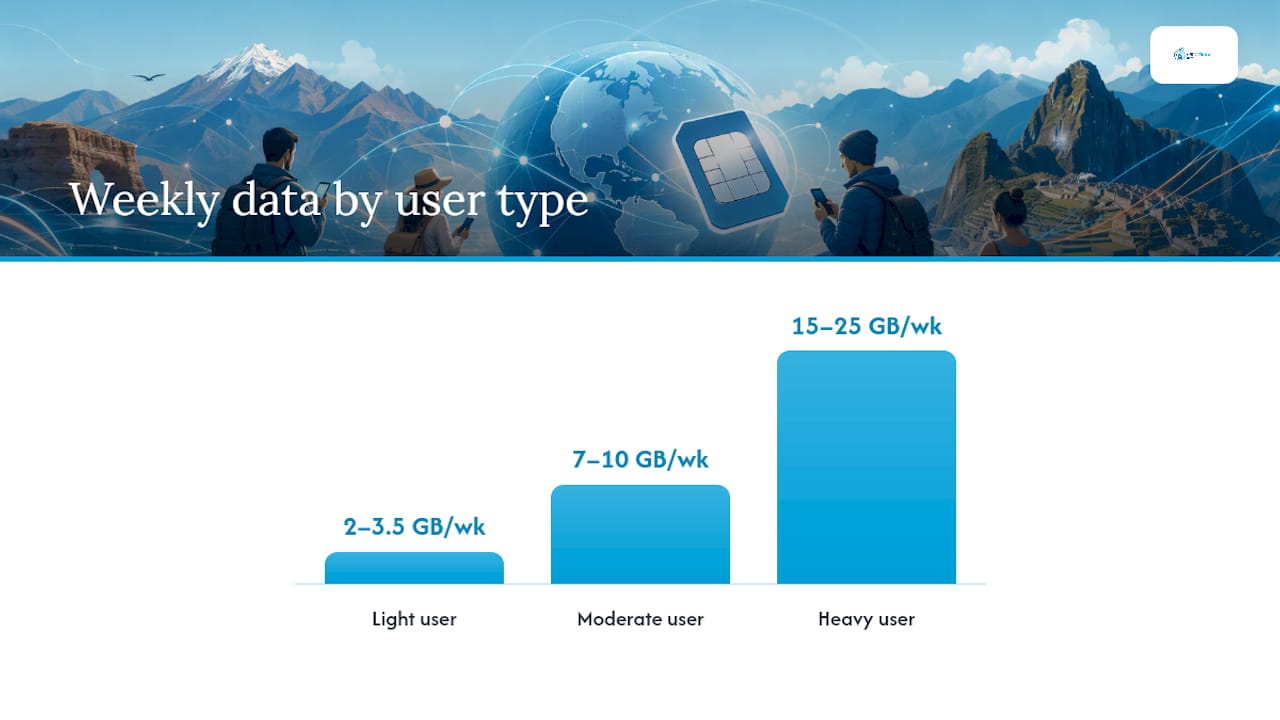
Most travel guides recommend a data range that covers typical 7 to 14 day trips for the average tourist, with unlimited plans mainly suited for heavy streamers and remote workers. That range holds up well against how people actually use their phones on a Peru itinerary, but the right number for you depends on which of three rough profiles you fall into.
- Light users rely on maps, WhatsApp, occasional photo uploads, and email. Budget roughly 300 to 500 MB per day, which puts a 7-day trip around 2 to 3.5 GB total.
- Moderate users add short video clips, social media browsing, and music streaming on top of navigation. Expect 1 to 1.5 GB per day, or 7 to 10 GB for a week.
- Heavy users stream video regularly, make video calls, or work remotely with cloud-based tools. That pushes daily use to 2 to 4 GB or more, meaning a week can burn through 15 to 25 GB fast.
Trip length scales the math directly. A 3-day Lima weekend for a light user needs barely 1.5 GB. A 14-day trip covering Lima, Cusco, and the Sacred Valley for a moderate user lands closer to 15 to 20 GB. A full month for a remote worker who’s on video calls daily is where an unlimited plan starts paying for itself rather than a large fixed allotment.
Video is the single biggest variable in that math. Streaming a single hour of standard-definition video can eat close to 1 GB, and high-definition playback roughly doubles that. If your evenings involve unwinding with a show back at the hostel, budget for it explicitly rather than assuming your “moderate” estimate will hold.
Pro Tip: Buy slightly more data than your estimate suggests, especially for treks. Offline map downloads, photo backups, and unexpected video calls to family always eat more than planned, and running out on day 12 of a 14-day trip is worse than a few unused megabytes at the end.
Hotspot use deserves its own note. Tethering a laptop or tablet to your phone’s eSIM connection is usually allowed on fixed-data plans, but it drains your allowance faster than phone-only use, since a laptop browser session or video call consumes far more than a phone screen doing the same task. Check the specific plan’s hotspot terms before relying on it for work.
Unlimited vs. Fixed Data Plans: How to Choose
The label “unlimited” rarely means what it sounds like. Most unlimited eSIM plans carry a fair-use policy (FUP), a daily or total-volume threshold after which your speed drops to a crawl, even though the plan technically never runs out. Reading that fine print before you buy matters more than the marketing headline, and customer reviews on platforms like Trustpilot are a useful gut check. Complaints about surprise throttling on “unlimited” plans show up often enough that it’s worth five minutes of research before checkout.
Cost-per-GB is where the real decision lives. A fixed 10 GB plan priced at a flat rate becomes a straightforward number: divide the price by 10 and you know your per-gigabyte cost. An unlimited plan only beats that math once your actual usage climbs past the point where the fixed plan’s per-GB rate would have cost more than the unlimited plan’s flat fee. For most travelers on a 7 to 14 day trip, that break-even point sits somewhere around 15 to 20 GB, right where heavy streamers and light remote workers start to live.
Run through this checklist before deciding:
- Trip length: Trips under a week rarely justify unlimited; the math favors fixed data almost every time.
- Primary activity: Streaming video, video calls, or cloud-based work push you toward unlimited. Navigation, messaging, and social browsing rarely do.
- Hotspot needs: If you’re tethering a laptop for work, factor that consumption into your estimate before assuming a fixed plan will cover it.
- Group sharing: If one eSIM is powering a hotspot for two or three travelers, size up regardless of individual habits.
- Budget flexibility: Unlimited plans cost more upfront; fixed plans reward disciplined data use with a lower price.
Esimglobe’s own comparison of unlimited data eSIM vs. fixed data plans breaks this trade-off down further if you want a deeper look at fair-use thresholds and when the flat-rate math tips in your favor. The short version: fixed data wins for most Peru trips under two weeks, and unlimited earns its price tag mainly for remote workers, content creators, and multi-week itineraries.
Which Networks Cover Peru Best?
Claro consistently ranks as the operator with the strongest overall network coverage across Peru, particularly once you leave Lima and other major cities behind. Movistar holds its own in urban centers and along the main tourist corridor, while Bitel and Entel fill in secondary coverage in specific regions but trail both on rural reach. That ranking matters directly to eSIM buyers, because the underlying network your eSIM registers on determines whether you get a bar of signal on a mountain pass or nothing at all.
Here’s what that looks like on the ground for a typical Peru itinerary:
- Lima: Full coverage across all major carriers; connectivity is rarely an issue in the capital.
- Cusco and the Sacred Valley: Strong coverage in town centers, spottier once you’re on rural roads between sites.
- The Inca Trail and high Andean passes: Independent signal maps and speed tests consistently show coverage gaps once you’re off the main highways and deep into trekking routes. Expect stretches with no signal at all, not just slow data.
- Arequipa and the southern coast: Generally reliable in town, weaker in the Colca Canyon backcountry.
- Amazon basin routes (Puerto Maldonado, Iquitos): Coverage thins out fast once you leave the river towns.
One practical advantage of a modern eSIM profile is that it isn’t locked to a single carrier the way an old-fashioned prepaid SIM often is. Travel testing on multi-network eSIM behavior shows that these profiles can register across more than one local carrier depending on which signal is strongest in a given location, which functions as automatic switching in the background. That’s a meaningful edge over buying a physical SIM tied to one operator’s tower map, since your phone can fall back to whichever network actually reaches you on a given stretch of road.
That said, a plan listed as running on Claro’s network is a strong indicator, not an absolute guarantee, of which tower your phone will actually register on in every location. Rural reception can push a device onto a secondary network for a stronger signal, and that’s generally a feature, not a bug.
For the Lima to Cusco to Sacred Valley route that most tourists follow, expect solid connectivity in every town and city, brief drops on mountain roads between them, and a real chance of zero signal if you detour onto the Inca Trail itself. Deep Andean valleys and multi-day treks are where even the best eSIM meets a hard physical limit: no signal tower means no signal, regardless of which provider sold you the profile. Serious trekkers heading into narrow valleys or remote passes should still download offline maps and consider a satellite messenger as backup, since cellular data alone can’t promise reception where there’s no infrastructure to connect to.
How to Get an eSIM for Peru: Step-by-Step
Getting connected before you land is a five-minute process if you do it right, and a frustrating one if you wait until you’re standing in the arrivals hall with 2% battery. Here’s the sequence that avoids the second scenario.
- Confirm your device is eSIM-compatible and unlocked. Most phones from the last four to five years support eSIM, but carrier-locked devices (especially ones bought on an installment plan) sometimes block third-party profiles. Check your phone’s settings under “Cellular” or “Mobile Data” for an option to add an eSIM before buying anything.
- Choose your plan on the Esimglobe Peru product page. Compare data tiers against the trip-length and usage estimates above, and pick the one that matches your actual itinerary rather than the cheapest option out of habit.
- Complete checkout in your preferred currency. The platform supports multiple currencies at checkout, so there’s no manual conversion step to second-guess.
- Receive your QR code or activation details by email, typically within minutes of payment clearing.
- Install the eSIM before you fly, ideally while you still have reliable Wi-Fi. Go to your phone’s cellular settings, select “Add eSIM,” and scan the QR code or enter the activation details manually if scanning isn’t available.
- Reboot your phone and select the new profile as your active data line, keeping your home SIM active for calls and texts if you’re running dual SIM.
- Turn on data roaming for the new eSIM profile specifically. This step trips people up more than any other: the eSIM can be installed correctly and still show no connection if roaming isn’t toggled on for that specific line.
Dual-SIM travelers should double-check that their phone allows two active data lines simultaneously; some models permit one SIM for calls and one eSIM for data, but not two active data connections at once. If you’re not sure, your phone’s manual or settings menu will specify the dual-SIM behavior for your exact model.
Pro Tip: Install and activate your eSIM the night before your flight, not while you’re waiting at the gate. Airport Wi-Fi is unreliable at the exact moment you need to download a QR code, and testing the connection before you fly means you land with a working phone instead of troubleshooting one.
If activation fails, the most common culprits are an incorrect date/time setting on the phone (toggle automatic time zone on), a QR code that’s already been scanned once and needs a manual code entry instead, or a device that technically supports eSIM but has it disabled by a carrier lock. Esimglobe’s support line runs 24/7 specifically because activation issues tend to surface at inconvenient hours, like the middle of an overnight flight. For general troubleshooting beyond Peru-specific setup, Esimglobe’s broader guide on staying connected abroad covers device settings that trip up first-time eSIM users.
What Does a Peru eSIM Cost in 2026?
Fixed-data Peru eSIM packages for a standard 7 to 14 day trip typically fall in a modest range, usually landing somewhere between a few dollars for a small data-saver plan and $30 to $50 for a generous 20 GB tier, depending on validity window and data volume. Short unlimited plans, when available for a single-country trip, tend to price higher than the fixed alternative, since you’re paying for certainty rather than a set volume.
The math that actually matters is price-per-gigabyte, not the sticker price alone. A $15 plan with 5 GB costs $3 per GB. A $30 plan with 20 GB costs $1.50 per GB, a better deal on paper, but only if you’ll genuinely use most of that allowance before it expires. Validity period matters just as much as data volume here.
- Check the validity window against your trip length. A 30-day validity plan is wasted money on a 5-day trip; a 7-day plan is a problem if your flight home gets delayed.
- Compare price-per-GB across tiers on the same product page, since larger data packages almost always carry a lower per-gigabyte rate.
- Watch for seasonal pricing shifts. Peak travel months to Peru (June through August, and around major holidays) sometimes see promotional pricing on regional and global plans as providers compete for volume.
- Check for site-wide coupon codes before checkout. Esimglobe periodically runs promotions on its plans, and a quick check before you pay can shave a meaningful percentage off a multi-week package.
A quick industry note worth flagging: independent testing comparisons across the eSIM market commonly recommend 5 to 20 GB for typical Peru trips, which lines up with the pricing tiers above. That consistency between usage guidance and pricing structure is a decent sanity check that a plan’s data allotment matches how people actually travel, rather than being padded or undersized relative to real demand.
Why Trust This Peru eSIM Recommendation?
Esimglobe’s Peru offering isn’t a theoretical pick pulled from a spec sheet. It’s a live product listing, the Peru 100MB 7Days plan, sitting alongside larger data tiers on the same Peru eSIM product page, where you can compare data volume, validity, and price before you buy anything.
This article was reported by daniele, drawing on telecoms and travel-industry background to evaluate how eSIM providers actually perform against traveler needs, not just marketing claims. That distinction matters in an industry where “unlimited” and “nationwide coverage” get used loosely.
A few concrete trust signals worth knowing before you buy:
- Instant delivery by email, generally within minutes of a completed purchase, with no waiting for a physical card to ship.
- 24/7 customer support, which matters most exactly when you’d expect: overnight flights, weekend arrivals, holiday travel when other providers’ support desks are closed.
- Multi-currency checkout, so international travelers pay in a currency they recognize rather than guessing at a conversion rate.
- A straightforward activation support process if a QR code fails to scan or a profile won’t connect, rather than a support ticket that sits unanswered for days.
A traveler landing at 11 p.m. in Lima with a dead international roaming plan and a rideshare app that won’t load isn’t a hypothetical. It’s the exact scenario instant email delivery and round-the-clock support exist to prevent, and it’s the clearest argument for buying and activating an eSIM before departure rather than after.
None of that replaces basic diligence on your end: confirm your device supports eSIM, check the data tier against your actual trip length, and read the fair-use terms if you’re considering an unlimited plan. But for the core question of which provider to trust with your Peru connectivity, a visible product page, transparent pricing tiers, and support that answers at 2 a.m. local time cover the fundamentals most travelers actually need.
My Take: What I’d Actually Tell a Friend Going to Peru
If a friend asked me point-blank, I’d tell them to buy Esimglobe’s Peru eSIM before they leave home, size it based on whether Cusco and the Sacred Valley are day trips or multi-day treks, and stop overthinking it beyond that. The data backs a fixed plan for most itineraries under two weeks, and the instant email delivery solves the one problem that actually ruins a first night abroad: no way to call a ride from the airport.
Where I’d add a caveat is the Inca Trail and any multi-day trek into the high Andes. No eSIM, including this one, promises signal where there’s no tower, and pretending otherwise does travelers a disservice. Download offline maps before you go, and if you’re doing a serious multi-day trek, treat cellular data as a bonus in town, not a guarantee on the trail. For travelers stacking Peru with other countries on the same trip, the global plans are the smarter buy over juggling separate eSIMs at every border, mostly because reinstalling profiles mid-trip is a hassle nobody needs on vacation.
If your itinerary is unusual, long treks, extended stays, business travel with heavy video call needs, it’s worth a look at the product page details or a quick message to support before you commit to a specific tier.
— daniele
Get Your Peru eSIM Before You Land
Esimglobe skips the airport SIM counter entirely. No line, no passport photocopy, no waiting for a physical card while your ride outside racks up a parking fee. You buy the plan, get your activation details by email in minutes, and land already connected.
Head to the Peru eSIM product page and pick the data tier that matches your trip length, whether that’s the Peru 100MB 7Days starter plan for a short visit or a larger allotment for two weeks covering Lima, Cusco, and the Sacred Valley. If Peru is one stop on a longer route, the eSIM Global (130+ areas) plan covers you across borders without a new purchase at every crossing, and works just as well if your next stop after South America is eSIM Dubai or another region entirely. Checkout runs in your preferred currency, support is available 24/7 if activation gives you trouble, and if you’re coordinating a longer stay with a vacation rental host, guest registration services can help streamline that side of the trip too. Buy before you fly, install on airport Wi-Fi or at home, and you’ll never see a “no signal” screen at baggage claim.
Further Reading and Data Sources
- nPerf world coverage map — An independent, crowd-sourced signal and speed test map useful for visualizing real coverage gaps on specific routes like the Inca Trail, rather than relying on carrier marketing claims.
- Monito’s Peru eSIM comparison — A broad market comparison of eSIM plans and pricing for Peru, useful for cross-checking data allowance norms against what you’re being offered.
- TravelTomTom’s Peru SIM guide — A practical, ground-level look at local carrier performance across Peru, including the case for Claro as the strongest rural network.
- Esimglobe’s eSIM vs. local SIM guide: A closer look at when a physical SIM still makes sense versus an eSIM, for travelers weighing both options.
FAQ
Which SIM card is best for traveling to Peru?
For most tourists, an eSIM beats a physical SIM because it activates before you land and avoids the airport SIM counter entirely. Esimglobe’s Peru eSIM covers the country’s main tourist routes and installs in minutes with no store visit required.
Which cell carrier has the best coverage in Peru?
Claro generally offers the strongest overall coverage in Peru, particularly outside major cities, with Movistar close behind in urban areas. Bitel and Entel fill in secondary coverage but trail both on rural reach, which is why multi-network eSIM profiles that can register on more than one carrier tend to perform better on remote routes.
Is there a better eSIM than other global providers for Peru?
Esimglobe stands out for Peru specifically because of its instant email delivery, 24/7 support, and pricing that scales cleanly from a short data-saver plan to a full multi-week package. Rather than comparing marketing claims, check the actual data tiers and validity windows on the Peru product page against your trip length.
How do I get an eSIM for Peru?
Buy a plan on Esimglobe’s Peru product page, receive your QR code or activation details by email within minutes, and install it through your phone’s cellular settings before you fly. Turn on data roaming for the new profile once you land, since that single toggle is the most common reason a correctly installed eSIM shows no connection.