






















TL;DR:
- Effective eSIM plan comparison requires analyzing cost per gigabyte, coverage, activation timing, and tethering policies to avoid overpaying. Many travelers mistakenly rely on “unlimited” labels, not realizing throttling reduces speeds after a daily high-speed data cap. Before purchasing, define trip needs and verify plan details to ensure optimal value and connectivity reliability.
Comparing eSIM plans effectively means evaluating coverage, data pricing, activation timing, and tethering policies before you book your first flight. Travelers who skip this step often overpay by 30% or more, buying data they never use or discovering their “unlimited” plan throttles to 2G speeds after the first gigabyte. This guide walks you through how to compare eSIM plans with a structured framework, covering every factor that separates a smart purchase from a costly mistake. Providers like Airalo, Holafly, and Saily each structure their plans differently, which makes side-by-side analysis the only reliable way to find genuine value.
How to compare eSIM plans: the essential factors
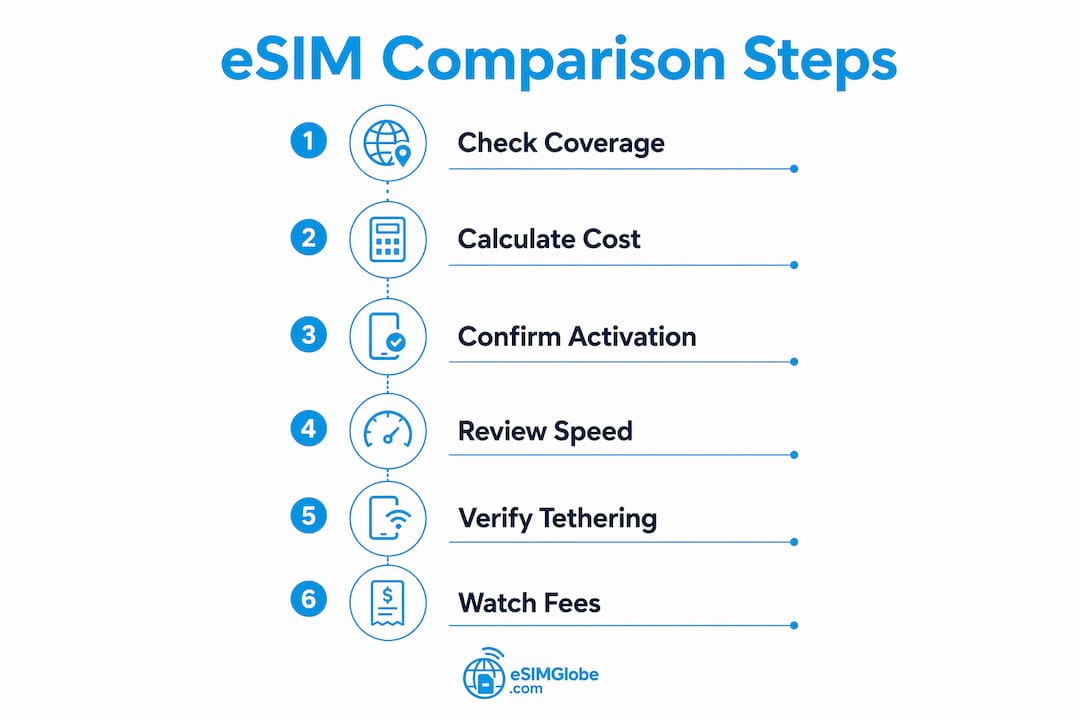
The most important metric in any eSIM plan comparison is the effective cost per gigabyte. A plan priced at $10 for 5GB costs $2 per GB, versus $2.67 per GB for an $8 plan with only 3GB. That difference compounds fast on a two-week trip. Always calculate cost per GB before committing to any plan.
Coverage and local carrier networks
Coverage is the first filter, not price. An eSIM that works on a strong local carrier in Tokyo may run on a weak roaming partner in rural Thailand. Before comparing prices, confirm which local carrier the eSIM connects to in each destination. Travelers using Esimglobe can filter by country and see carrier details directly on the plan listing.

Data allowance and validity period
Data allowance and plan validity are two separate variables. A 10GB plan valid for 7 days suits a short business trip. That same plan valid for 30 days suits a backpacker. Mismatching these two factors is one of the most common and avoidable mistakes travelers make.
Activation timing
Activation timing matters more than most travelers realize. Some eSIM plans start their validity clock the moment you install the profile on your phone. Others start only when your device first connects to a local network. Installing a plan two days before departure on a “starts on installation” plan wastes exactly two days of paid validity.
Pro Tip: Always read the activation trigger in the plan description. Look for the phrase “validity starts on first use” to confirm your clock does not start until you land.
Speed limits and throttling
Speed caps are standard practice across the industry. Most plans advertise 4G or LTE speeds, but many reduce speeds after a daily threshold. Unlimited plans throttle speeds after 1–3GB of high-speed data per day. That means streaming video or video calls in the evening may run at frustratingly slow speeds if you used your high-speed allowance earlier.
Tethering and hotspot policies
Tethering policies vary significantly between providers and plan types. Some unlimited plans either restrict hotspot use entirely or charge extra for it. If you plan to share your connection with a laptop or tablet, confirm tethering is explicitly allowed before purchasing. This detail is buried in the fine print on many provider sites.
Hidden fees and refund policies
Hidden fees such as activation charges or currency conversion costs can push the real price well above the headline rate. Always check the total checkout price, not the advertised plan price. Refund policies also differ: some providers offer no refunds once an eSIM is installed, even if it fails to connect.
What tools and techniques help you find the best plan?
Defining your trip constraints before opening any comparison tool is the single most effective way to avoid impulse purchases. Start selection before travel by writing down your destination countries, estimated daily data use, trip length, and whether you need hotspot capability. That list becomes your filter.
A step-by-step comparison process
Follow this sequence to compare eSIM options without getting overwhelmed:
- List your destinations. Single country, multi-country, or regional coverage. This determines which plan types are even eligible.
- Estimate your daily data use. Light use (maps, messaging) runs about 200–500MB per day. Heavy use (streaming, video calls) can exceed 2GB per day.
- Set your validity window. Match plan length to your trip dates, not just the number of days you are active.
- Calculate cost per GB for each shortlisted plan. Divide total price by total data. Lower is better, but only if coverage and speed meet your needs.
- Check activation trigger, tethering rules, and refund policy. These three details eliminate many plans that look good on price alone.
- Compare at least three plans side by side. Side-by-side comparison tools like Esimdude, Esimcompare, and eSIMDB update daily and let you filter by country, data size, and trip length.
Understanding regional vs. single-country plans
The table below shows how plan types stack up across the key comparison dimensions:
| Factor | Single-Country Plan | Regional Bundle |
|---|---|---|
| Cost per GB | Lower for long stays | Higher but convenient |
| Coverage | One country only | Multiple countries |
| Best for | Stays of 5+ days in one place | Short hops across borders |
| Flexibility | Buy only what you need | One purchase covers all |
| Activation complexity | Simple | Varies by provider |
Pro Tip: Use Esimglobe’s country selector to pull up all available plans for your destination in one view. Sort by cost per GB to immediately identify the best value options without manual math.
What pitfalls should travelers avoid when choosing an eSIM?
The biggest mistake travelers make is treating “unlimited” as a literal description. Unlimited plans implement throttling after specific daily data thresholds, which is critical to know if you plan heavy streaming or hotspot use. The word “unlimited” refers to the data volume, not the speed at which you receive it after the daily cap.
Here are the most common and costly errors to avoid:
- Buying without checking tethering rules. Travelers who need to connect a laptop discover too late that their plan blocks hotspot use entirely.
- Activating the eSIM at home. Installing a plan that starts validity on installation wastes paid days before you even board the plane.
- Overbuying data on short validity plans. A 20GB plan on a 7-day trip sounds generous until you realize you only use 4GB and the rest expires.
- Assuming regional plans are always cheaper. Regional bundles suit short hops, but for a 10-day stay in one country, a local single-country plan almost always costs less per GB.
- Ignoring provider reputation. A low price from an unknown provider with no customer support is a risk. If the eSIM fails to connect, you have no recourse.
- Skipping the refund policy. Many providers offer zero refunds after installation. Read this policy before you pay.
“Many travelers wait to pick eSIMs until arrival. Pre-trip selection after defining needs prevents impulse buys and better fits actual usage patterns.” — How to Choose eSIM: 2026 Guide
The activation timing issue deserves extra attention. Confirm activation triggers before installing any eSIM profile. Plans that start on first network use give you the flexibility to install in advance without losing validity. Plans that start on installation should only be added to your device on the day of travel or after arrival.
How do the different types of eSIM plans compare?
eSIM plans fall into three main categories: fixed data, unlimited with a Fair Use Policy, and pay-as-you-go. Each type suits a different traveler profile. Choosing the wrong type is as costly as choosing the wrong price.
Fixed data plans
Fixed data plans give you a set amount of data at full speed for the plan’s validity period. They are the most predictable option. A traveler who uses maps, messaging apps, and occasional email fits comfortably within a 3–5GB fixed plan for a week. These plans are also the easiest to compare because the cost per GB calculation is straightforward.
Unlimited plans with fair use policies
Unlimited plans appeal to heavy users, but the Fair Use Policy is the critical detail. Most providers throttle speeds after 1–3GB of daily high-speed data. After that threshold, speeds drop to levels that make streaming or video calls impractical. These plans work well for travelers who need consistent low-speed connectivity throughout the day rather than bursts of high-speed activity.
Pay-as-you-go plans
Pay-as-you-go plans charge by the megabyte or day rather than selling a fixed bundle. They suit travelers with unpredictable itineraries or very short trips. The per-unit cost is higher, but you never pay for unused data. Travelers doing a 48-hour layover or a weekend trip benefit most from this structure.
When to stack local plans vs. buy a regional bundle
| Scenario | Best Plan Type |
|---|---|
| 10 days in one country | Single-country fixed data plan |
| 3 countries in 2 weeks | Regional bundle |
| Unpredictable multi-stop trip | Pay-as-you-go or regional bundle |
| Heavy hotspot use needed | Fixed data with confirmed tethering |
| Budget-first priority | Stack local plans per country |
Stacking local plans for a multi-country trip with deep stays in one country often costs less than a regional bundle. Regional bundles price in the convenience of cross-border coverage. If you spend 80% of your trip in one country, you are paying for coverage you rarely use.
Pro Tip: For trips covering three or more countries with stays under four days each, a regional bundle from Esimglobe typically delivers better value than managing multiple single-country activations.
Key takeaways
The most effective way to compare eSIM plans is to calculate cost per GB, confirm activation timing, and verify tethering rules before purchasing any plan.
| Point | Details |
|---|---|
| Cost per GB is the primary metric | Divide total plan price by total data to find real value, not just headline price. |
| Activation timing affects validity | Plans that start on installation waste days if added before departure. |
| “Unlimited” always has limits | Fair Use Policies throttle speeds after 1–3GB of daily high-speed data. |
| Plan type must match trip style | Fixed data suits predictable trips; regional bundles suit multi-country short hops. |
| Define needs before shopping | List destinations, daily data use, and hotspot needs before opening any comparison tool. |
Why most travelers overpay for eSIM plans
I have reviewed hundreds of eSIM plans across dozens of providers, and the pattern is consistent. Travelers overpay not because good deals are hard to find, but because they start shopping without a defined set of requirements. They see a low headline price and buy without checking the cost per GB, the activation trigger, or the tethering rules.
The “unlimited” label causes the most confusion. Travelers assume it means unrestricted high-speed data for the full validity period. It does not. After the daily high-speed threshold, speeds drop to levels that make the plan functionally limited for anything beyond basic messaging. Providers are not hiding this. It is in the plan description. But travelers who do not know to look for it get surprised every time.
My practical advice: treat eSIM shopping like booking a flight. You would not book without checking the dates, the baggage policy, and the cancellation terms. Apply the same discipline here. Check eSIM purchasing tips before you travel, not after you land with no data and a plan that started counting down two days ago.
Esimglobe stands out because its plan database updates daily, which means the prices and availability you see are current. Many comparison sites show stale data, which leads to checkout surprises. For travelers who want reliable, current information without sorting through inconsistent provider sites, Esimglobe is the clearest starting point I have found.
— daniele
Compare and buy eSIM plans on Esimglobe
Esimglobe gives international travelers a single platform to compare, buy, and manage eSIM plans across hundreds of destinations. The plan database updates daily, so prices and availability reflect current market conditions rather than outdated listings.
Every plan listing on Esimglobe includes carrier details, activation type, tethering policy, and total cost with no hidden fees. Travelers can filter by country, data size, and validity period to find the right match in minutes. For travelers who want to go deeper on affordable connectivity abroad, Esimglobe’s resource library covers every major destination and travel scenario. Start your comparison before you pack.
FAQ
What is the most important factor when comparing eSIM plans?
The effective cost per GB is the primary comparison metric. Divide the total plan price by the total data allowance to find real value, then verify coverage, activation timing, and tethering rules before purchasing.
Do unlimited eSIM plans actually give unlimited data?
No. Unlimited plans throttle speeds after a daily high-speed threshold, typically 1–3GB per day. After that limit, speeds drop significantly, making the plan unsuitable for streaming or video calls.
When should i activate my eSIM before traveling?
Only activate your eSIM after confirming the activation trigger. Plans that start validity on installation should be added on the day of travel or after arrival. Plans that start on first network use can be installed in advance without losing paid days.
Are regional eSIM bundles better than single-country plans?
Regional bundles are more convenient for multi-country trips with short stays in each location. For trips with long stays concentrated in one country, stacking single-country plans typically costs less per GB than a regional bundle.
How do i check if an eSIM plan supports hotspot or tethering?
Read the plan description carefully before purchasing. Tethering policies vary by provider and plan type. Some unlimited plans restrict or block hotspot use entirely. Confirm tethering is explicitly permitted if sharing your connection with other devices is part of your travel setup.