






















TL;DR:
- A local eSIM plan connects your device to a country’s network at domestic rates without a physical SIM card. It offers advantages over roaming by providing local numbers, full speeds, and lower costs depending on your trip duration and location. Choosing the right eSIM plan depends on your travel itinerary, data needs, and device compatibility to ensure seamless connectivity.
An eSIM local plan is a digital SIM profile tied to a carrier in your destination country, giving your phone access to that country’s mobile network without a physical SIM card. Clarifying eSIM local plans matters because most travelers still confuse them with global roaming bundles or regional eSIM packages, and that confusion leads to overpaying or losing connectivity at the worst moment. The core difference is simple: a local eSIM connects you to a domestic network at domestic rates, while your home carrier roaming plan charges you international fees. Platforms like Esimglobe make it possible to purchase and install these digital profiles before you board your flight, so you land connected.
What are eSIM local plans and how do they differ from roaming?
An eSIM local plan gives your device a local phone number profile from a carrier in the country you are visiting, activated entirely over the internet. No SIM tray, no card swap, no waiting at an airport kiosk. You download the profile via a QR code or an app, and your phone registers on the local network as if you bought a SIM card in that country.

International roaming works differently. Your home carrier negotiates access to a foreign network and charges you a markup, often several dollars per megabyte or a flat daily fee. That fee covers convenience but rarely covers value. A week of roaming in Europe through a U.S. carrier can cost more than a month of local data through a destination eSIM.
Global and regional eSIM bundles sit between these two options. A regional plan covers multiple countries under one data pool, which is practical for a two-week trip across five countries. Regional bundles trade convenience for some speed restrictions and less consistency compared to a true local eSIM. You get coverage everywhere, but you may not always get the fastest local speeds.
| Feature | Home carrier roaming | Local eSIM plan | Regional eSIM bundle |
|---|---|---|---|
| Cost per GB | High | Low | Medium |
| Local phone number | Yes (home number) | Sometimes | Rarely |
| Network speed | Varies | Usually full domestic speed | Varies by country |
| Voice and SMS | Full | Plan-dependent | Usually data-only |
| Setup effort | None | Low | Low |
| Best for | Short trips, emergencies | Single-country stays | Multi-country trips |
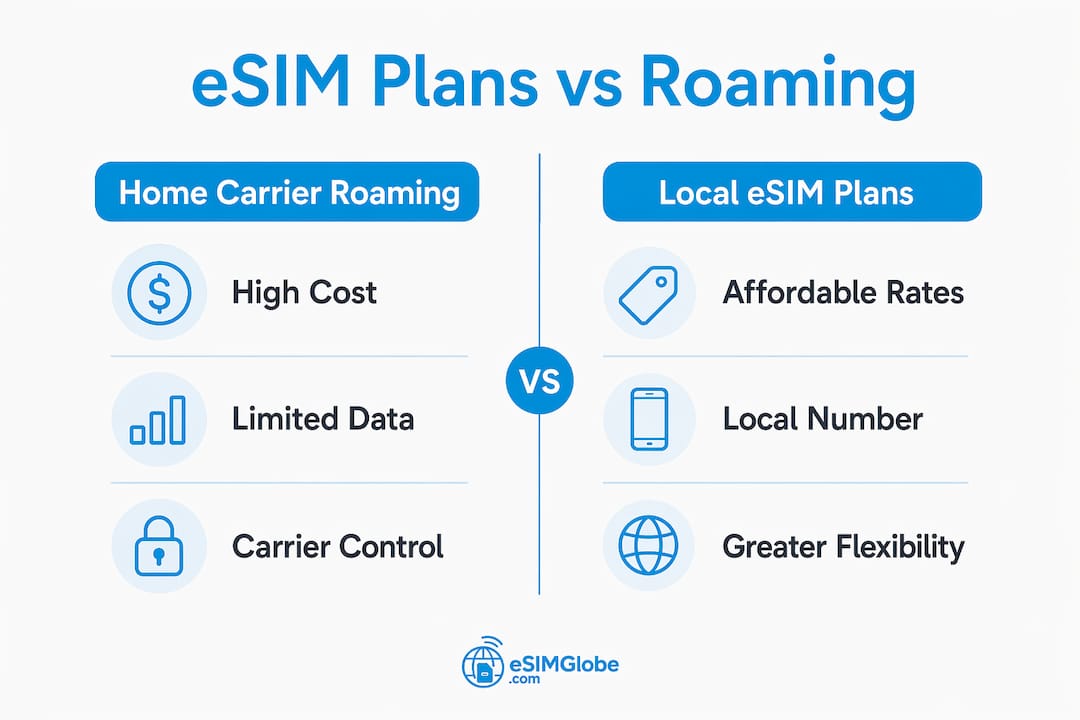
The right choice depends on your trip structure. A weekend in Tokyo calls for a local Japan eSIM. A three-week backpacking route through Southeast Asia calls for a regional bundle. A two-month stay in Germany calls for a local German eSIM with a local number.
What features and restrictions should you look for in eSIM local plans?
Network coverage is the first thing to check. A plan is only as good as the carrier it runs on, and network partnerships matter more than the eSIM brand name itself. A plan that partners with the dominant local carrier will outperform a cheaper plan running on a secondary network, especially in rural areas.
Data volume and speed tier come next. Most local eSIM plans offer tiered options ranging from a few gigabytes for short visits to unlimited data for longer stays. Unlimited plans often include fair-use throttling after a set threshold, so read the fine print before assuming “unlimited” means full speed all month.
These are the key features to evaluate before buying any local eSIM plan:
- Network tier: Does the plan run on the country’s primary carrier or a secondary one?
- 5G availability: Is 5G included, or is the plan capped at LTE?
- Voice and SMS: Most travel eSIMs are data-only, requiring VoIP apps like WhatsApp or FaceTime for calls. If you need a real local number for banking or ride-share apps, confirm the plan includes voice and SMS.
- Tethering and hotspot: Tethering permissions vary widely across plans. Some ban it entirely. Some cap it at a separate data limit. Sim Local, for example, offers plans where hotspot is included with no connection limits, which sets it apart from many competitors.
- Refund and cancellation policy: Can you get a refund if the plan fails to activate? Check this before purchase.
- Activation support: Does the provider offer live chat or email support if something goes wrong?
Device compatibility is non-negotiable. Your phone must support eSIM technology and be carrier-unlocked. Even eSIM-capable devices fail to activate if they are still locked to a home carrier. Check your phone’s unlock status before you travel, not at the airport.
Pro Tip: Test your eSIM plan’s hotspot function on the day you activate it, not the day you need it for a work call. Tethering failures are common and often require a support ticket to resolve.
Travelers who rely heavily on calls and SMS, such as those using local banking apps or ordering food delivery, need a plan that explicitly includes voice and SMS or a local number. Data-only plans work for most casual travelers but create friction for anyone who depends on SMS verification codes.
How to choose the best eSIM local plan based on your travel profile
The right local eSIM plan depends on four factors: trip length, number of countries, data needs, and whether you need a local phone number. Getting clear on these four points before you browse any plan catalog saves time and prevents buyer’s remorse.
Follow this workflow to match your profile to the right plan:
- Confirm your device is unlocked. This is the prerequisite for everything else. An unlocked phone accepts any eSIM profile. A locked phone accepts none.
- Count your countries. If you are visiting one country, a local eSIM is almost always the best value. If you are visiting three or more, a regional bundle is more practical.
- Estimate your daily data use. Streaming video uses roughly 1 GB per hour. Navigation and messaging use far less. Pick a plan with at least 20% more data than your estimate to avoid running out.
- Decide on voice and SMS. If you need a local number for banking apps or two-factor authentication, filter only for plans that include voice and SMS. If VoIP works for you, data-only plans are cheaper.
- Check tethering rules. Digital nomads who connect laptops through their phone must confirm hotspot is permitted. Local eSIMs are usually cheaper per GB and sometimes include local numbers, making them the best fit for extended single-country stays.
- Buy before you fly. Purchase and download the eSIM profile while you still have reliable home Wi-Fi. Activation at an airport or hotel is possible but adds unnecessary stress.
Two scenarios illustrate how this plays out in practice. A traveler flying to Paris for a long weekend needs a France local eSIM with 5–10 GB of data and no voice requirement. A freelancer relocating to Japan for three months needs a Japan local eSIM with a local number, generous data, and confirmed hotspot access for laptop work.
For multi-country trips, a practical approach is to start with a regional eSIM plan for the first leg, then switch to a local eSIM once you settle in one country for more than a week. Keep your home SIM active but disable its data roaming. Your home number stays reachable for calls and SMS verification, while the local eSIM handles all data at local rates.
Label your eSIM lines clearly in your phone settings. Most dual-SIM phones let you name each line. Naming them “Home” and “Japan Data” prevents accidental roaming charges when your phone defaults to the wrong line.
How to activate and manage eSIM local plans effectively
Activation is straightforward when you prepare correctly. Successful eSIM activation requires a strong Wi-Fi connection, a disabled VPN, and a carrier-unlocked phone. Skipping any of these three steps is the most common cause of provisioning failure.
| Activation step | Common issue | Fix |
|---|---|---|
| Scan QR code | VPN blocks the download | Turn off VPN before scanning |
| Profile installs but no signal | Phone still carrier-locked | Contact home carrier to unlock |
| Data works but hotspot fails | Plan does not include tethering | Contact provider or upgrade plan |
| Profile not found after scan | QR code scanned twice | Request a new QR code from provider |
| Calls not working | Plan is data-only | Use WhatsApp, FaceTime, or Google Meet |
Once the profile is installed, label your lines immediately. Go to your phone’s cellular settings and rename each SIM. Set the local eSIM as your default data line. Keep your home SIM set to calls and SMS only, with data roaming turned off.
Pro Tip: Disable data roaming on your home SIM the moment your local eSIM is active. One accidental roaming session can generate charges that exceed the cost of your entire eSIM plan.
Managing data use during your trip is straightforward. Most phones show per-line data consumption in the cellular settings menu. Check it every few days on longer trips. If your plan includes a top-up option, buy it before you hit zero. Running out of data mid-trip and scrambling for a new plan wastes time.
For travelers using multiple eSIMs across a long trip, keep a simple note in your phone listing each plan’s name, data balance, and expiration date. Switching between eSIM profiles takes seconds on most modern phones, but knowing which plan is active prevents confusion. If you run into activation problems, contact your provider’s support team directly. Reputable providers like those listed on Esimglobe offer support channels to resolve issues quickly.
Key takeaways
Choosing the right local eSIM plan requires matching your trip length, country count, data needs, and voice requirements to a plan with verified network quality and clear tethering rules.
| Point | Details |
|---|---|
| Local eSIM vs. roaming | Local eSIM plans connect at domestic rates; home carrier roaming charges international markups. |
| Voice and SMS gap | Most travel eSIMs are data-only; confirm voice and SMS inclusion if you need local number verification. |
| Tethering is not guaranteed | Always check hotspot permissions before buying, especially if you work from a laptop while traveling. |
| Device unlock is required | A carrier-locked phone cannot activate any eSIM profile, regardless of device eSIM capability. |
| Plan quality over brand | Network partnerships determine real-world speed more than the eSIM provider’s marketing claims. |
What I have learned from using eSIM local plans across multiple trips
The single biggest mistake I see travelers make is assuming tethering is included. They buy a data plan, land, activate it, and then discover their laptop cannot connect because the plan silently bans hotspot use. That discovery happens at the worst possible time, usually in a hotel room the night before a client meeting. Always read the tethering policy before you pay.
The second mistake is leaving phone unlocking until the last minute. Carrier unlock requests can take 24–72 hours to process, and some carriers require you to submit the request while still in your home country. Confirm your phone is unlocked at least a week before departure.
One thing most articles miss: keep your home SIM active and set it to calls and SMS only. Banking apps, two-factor authentication, and ride-share services often send verification codes to your home number. Losing access to those codes because you removed your home SIM creates real problems. The local eSIM handles data. The home SIM handles identity verification. That split works well.
Network quality is the factor travelers underestimate most. A plan that runs on a country’s top carrier will outperform a cheaper plan on a secondary network, sometimes dramatically. Before buying, check which carrier the plan partners with. Prioritizing strong local infrastructure partnerships delivers a better experience than chasing the lowest price.
Test your plan the moment you land, ideally on airport Wi-Fi before you leave the terminal. Load a webpage, run a speed test, and confirm hotspot works if you need it. Catching a problem at the airport gives you time to contact support while you still have Wi-Fi access.
— daniele
Esimglobe: browse local eSIM plans for your next trip
Travelers who want clear, verified local eSIM options for any destination can browse the full catalog at Esimglobe. The platform lists plans across countries and regions, with filters for data volume, duration, and voice inclusion, so you can match a plan to your exact trip profile without guesswork.
Esimglobe covers destinations from single-country local plans to multi-region bundles, with pricing displayed in USD, EUR, and GBP. Whether you are planning a weekend city break or a three-month relocation, the international traveler’s guide on Esimglobe walks you through plan selection step by step. For travelers finalizing their 2026 trip plans, the 2026 purchasing tips page covers the latest plan options and activation best practices.
FAQ
What is an eSIM local plan?
An eSIM local plan is a digital SIM profile from a carrier in your destination country, installed on your phone over the internet. It gives your device access to the local network at local data rates, without a physical SIM card.
Do eSIM local plans include calls and SMS?
Most travel eSIMs are data-only and do not include a traditional phone number. Travelers who need voice calls or SMS verification should specifically filter for plans that include voice and SMS, or use VoIP apps like WhatsApp for calls.
Can I use my eSIM as a hotspot?
Hotspot permissions vary by plan. Some plans include unlimited tethering, others ban it entirely. Check the plan’s tethering policy before purchasing, particularly if you plan to connect a laptop.
Does my phone need to be unlocked for an eSIM?
Yes. Your phone must be carrier-unlocked to accept an eSIM profile from a foreign provider. A locked device cannot activate any eSIM plan, even if the phone technically supports eSIM technology. Contact your home carrier to request an unlock before you travel.
When should I choose a regional eSIM instead of a local plan?
A regional eSIM bundle is the better choice when you are visiting three or more countries on a single trip. For stays of more than one week in a single country, a local eSIM plan typically offers better speeds and lower cost per gigabyte.