






















TL;DR:
- Roaming charges in Vietnam often exceed $10 daily, but using an eSIM purchased before departure offers a cheaper, seamless connection. Installing the eSIM profile at home and activating it in Vietnam ensures reliable service without the bother of physical SIM swaps or airport kiosks. Choosing the right plan based on coverage and data needs, and checking device compatibility, optimizes savings and connectivity for every traveler.
Roaming charges in Vietnam can quietly wreck a travel budget. Standard international data rates from major carriers regularly exceed $10 per day, and navigating crowded airport SIM card kiosks while jet-lagged adds friction nobody needs. The assumption that expensive roaming or a physical SIM swap are the only options is wrong. An eSIM for Vietnam gives you a cleaner path: buy a plan online before departure, install it on your device at home, and arrive in Vietnam already connected. This guide covers exactly how that works, which networks matter, and how to keep costs low whether you are visiting for five days or five months.
Table of Contents
- How eSIMs work in Vietnam: The basics you must know
- Choosing the right eSIM plan: Coverage, data, and host networks
- How to install and activate your eSIM: A step-by-step guide
- Cost-saving tips for digital nomads and long-stay travelers
- What most Vietnam eSIM guides miss: Real-world lessons for savvy travelers
- Navigate your Vietnam journey with reliable, affordable eSIMs
- Frequently asked questions
Key Takeaways
| Point | Details |
|---|---|
| Install before departure | Download your eSIM profile on Wi-Fi at home for the smoothest activation in Vietnam. |
| Choose network wisely | Viettel-backed eSIMs usually provide the best rural coverage, while urban travelers have more options. |
| Match plan to trip | Short visits suit unlimited plans, long stays and digital nomads often save more with fixed-data eSIMs. |
| Check for hotspot support | Always confirm your eSIM plan allows hotspot/tethering if you need to connect a laptop or tablet. |
How eSIMs work in Vietnam: The basics you must know
An eSIM is a digital SIM card embedded directly in your device. Unlike a physical nano-SIM, it holds multiple operator profiles and switches between them in software. Most smartphones released after 2020 support eSIM, including flagship iPhone models from iPhone XS onward, Google Pixel 3 and later, and a wide range of Samsung Galaxy devices. Tablets, smartwatches, and some laptops also support eSIM, though plan compatibility varies by device category.
Understanding the difference between installation and activation is essential before you travel. These are two separate steps, and confusing them is the most common setup mistake.
- Installation: Downloading the eSIM profile from your provider onto your device. This happens over Wi-Fi and typically takes under two minutes. You scan a QR code provided by your eSIM vendor, and the profile is saved to your phone’s eSIM settings.
- Activation: Switching your default data line to the new eSIM profile. This is what actually connects you to a local Vietnamese network and, in most cases, starts your plan’s data clock.
The practical implication: install the profile at home on a stable Wi-Fi connection, but do not activate until you land. As the Vietnam eSIM Guide: 30 Questions explains, typical Vietnam eSIMs are delivered via QR-code activation, and the recommended approach is to install at home and activate in Vietnam for best reliability.
Installing your eSIM profile before boarding means you skip the airport SIM hunt entirely. The moment your plane lands, switching your data line takes about ten seconds.
Once installed, your phone can hold both your home carrier SIM and the Vietnam eSIM simultaneously. You set the Vietnam eSIM as the default data line while keeping your home number active for calls and texts. No physical SIM swap required. No risk of losing a tiny card in a foreign country.
What to do if QR code scanning fails: Some devices running older firmware have trouble scanning eSIM QR codes. Most providers supply a manual activation code as a backup. Go to your device’s cellular settings, select “Add eSIM,” choose “Enter details manually,” and type the activation code string provided in your purchase confirmation email. If that also fails, contact your eSIM provider’s support chat before your departure date, not at the airport.
Pro Tip: Check your device’s eSIM compatibility on the manufacturer’s website before purchasing any plan. Also confirm that your device is carrier-unlocked; a locked phone will reject any foreign eSIM profile. Reviewing essential eSIM facts before your first purchase can save significant frustration.
Choosing the right eSIM plan: Coverage, data, and host networks
Not all Vietnam eSIM plans connect to the same local network. The plan you buy determines which Vietnamese carrier’s towers your phone uses, and that choice has real consequences depending on where you are traveling.
Vietnam has three dominant mobile networks: Viettel, VNPT/Vinaphone, and MobiFone. Each has a distinct coverage profile. As noted in research on the best eSIM for Vietnam, some plans are marketed around specific host networks, and the best choice depends on itinerary geography. Viettel operates the largest tower network in Vietnam, covering rural provinces, mountainous northern regions, and popular but remote routes like the train corridor between Hanoi and Ho Chi Minh City. Ha Long Bay cruise areas also favor Viettel connectivity. VNPT/Vinaphone and MobiFone perform well in dense urban environments like Ho Chi Minh City, Hanoi, Da Nang, and Hoi An, where multiple networks compete with strong 4G signals.

For travelers sticking to major cities and tourist circuits, any of the three networks will serve adequately. For travelers venturing off the beaten path into the Central Highlands, Ha Giang Loop, or remote Mekong Delta villages, a Viettel-based plan is the practical choice.
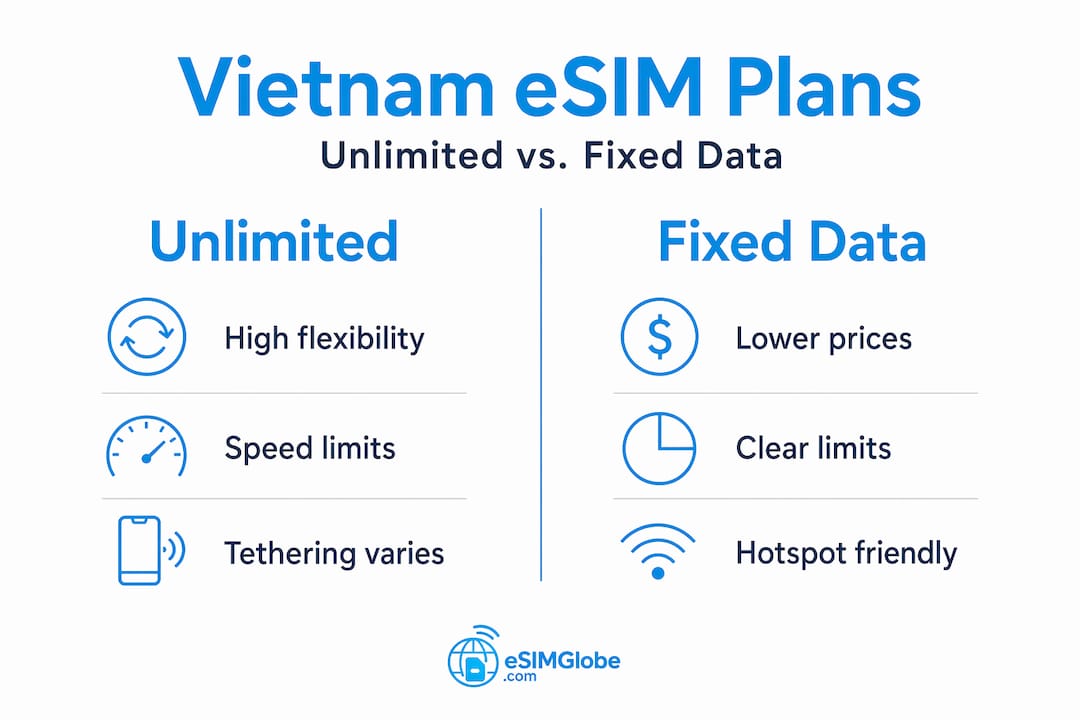
Plan types: Unlimited vs. fixed data
| Plan type | Best for | Typical price range | Data cap behavior | Tethering support |
|---|---|---|---|---|
| Fixed data (1GB to 10GB) | Short trips, light users | $3 to $12 | Hard cutoff or speed throttle | Usually included |
| Fixed data (20GB to 50GB) | Medium stays, moderate use | $10 to $25 | Speed throttle after cap | Often included |
| Unlimited (fair use policy) | Digital nomads, streamers | $15 to $40 | Throttled after daily/weekly cap | Varies by provider |
| Regional/multi-country | Travelers crossing borders | $20 to $60 | Varies per country allocation | Varies by provider |
The Unlimited Vietnam eSIM category is growing in popularity, particularly among remote workers. However, “unlimited” rarely means truly unlimited at full speed. Most plans throttle data to 1Mbps or lower after a daily threshold, often between 1GB and 3GB per day at 4G speeds.
Pro Tip: Match your plan to your specific route before buying. If your itinerary includes Sapa, Ha Giang, or rural Mekong Delta areas, prioritize a Viettel-based plan. For urban-only trips to Ho Chi Minh City and Da Nang, any major network works. Reviewing resources on choosing the best eSIM for travel gives useful frameworks for evaluating plans beyond Vietnam as well.
Vietnam’s 4G coverage reaches approximately 95% of the population, with 5G available in select urban zones as of 2026. Most eSIM plans default to 4G/LTE, which is more than adequate for video calls, streaming, and remote work tasks.
How to install and activate your eSIM: A step-by-step guide
Installing a Vietnam eSIM is straightforward when you follow the steps in the right order. Skipping ahead or doing steps out of sequence is where travelers run into trouble. The core principle, as described in the Vietnam eSIM Guide: 30 Questions, is to install the eSIM profile before travel on Wi-Fi, then activate in Vietnam by switching the default data line.
Here is the full process from purchase to active connection:
- Purchase your plan. Select a Vietnam eSIM plan from your provider. You will receive a confirmation email containing a QR code and, in most cases, a manual activation code as backup. Save both.
- Check your device is eSIM-compatible and unlocked. Go to your phone’s cellular settings and verify eSIM functionality. If your device shows a “Add eSIM” or “Add data plan” option, you are good.
- Install the eSIM profile at home on Wi-Fi. Open your phone’s camera or cellular settings and scan the QR code. Accept the prompts to download and install the eSIM profile. The profile will appear in your cellular settings as a secondary line, usually labeled with the provider’s name or “Travel eSIM.”
- Do not activate yet. Leave your home carrier as the default data line until you reach Vietnam. Activating early may start your plan’s validity period before you need it.
- Verify plan start conditions. Some plans activate automatically on first data use. Others start from the moment of activation. Read your plan’s terms carefully to avoid burning days before departure.
- On arrival in Vietnam, go to cellular settings and switch the default data line to your Vietnam eSIM. You should connect to a local network within 30 to 60 seconds.
- Test connectivity before leaving the airport. Open a browser or run a speed test. Confirm you are on a local Vietnamese network, not roaming on your home carrier.
- Keep your home SIM active for calls and texts if your plan supports dual-SIM functionality. Most modern eSIM-compatible devices handle this natively.
What happens if setup fails at step 3? Do not panic. Use the manual activation code: navigate to Settings, Cellular (or Mobile Data), Add eSIM, Enter Details Manually, and input the code string. Still failing? Contact provider support via chat from your home Wi-Fi before you board.
Pro Tip: Immediately after landing, test your connection before exiting the arrivals hall. Airport arrival zones in Vietnam’s major airports (Noi Bai in Hanoi, Tan Son Nhat in Ho Chi Minh City) have strong 4G signal. If your eSIM is not connecting there, it will not connect outside either, and you can seek help or use airport Wi-Fi to contact support. Following practical eSIM travel tips like this one prevents the most common arrival-day connectivity failures.
Cost-saving tips for digital nomads and long-stay travelers
For travelers staying in Vietnam longer than two weeks, the math on eSIM spending changes significantly. Short-trip buyers often default to unlimited plans out of convenience. Long-stay travelers who plan more carefully usually pay less for the same or better connectivity.
The core trade-off, as research on the best eSIM for Vietnam confirms, is that unlimited plans are convenient for unpredictable workloads, but fixed-data plans tied to strong host networks can be much cheaper for long stays. A 30-day unlimited plan might run $30 to $40. A carefully chosen 20GB fixed-data plan on the same network might cost $12 to $18 and be more than sufficient for a traveler who uses coffee shop Wi-Fi for heavy downloads.
Key strategies to minimize eSIM spend
- Use free Wi-Fi for heavy tasks. Vietnam has excellent café Wi-Fi culture in cities like Hanoi, Ho Chi Minh City, and Da Nang. Reserve your mobile data for navigation, messaging, and quick lookups. Stream video over Wi-Fi whenever possible.
- Stack plans strategically. Many eSIM providers allow you to purchase add-on data packs or a second plan when your first runs low. Stacking a smaller initial plan with a top-up is often cheaper than buying a large plan upfront.
- Confirm tethering/hotspot support before purchasing. If you need laptop connectivity for remote work, your phone’s eSIM plan must explicitly support hotspot use. Not all plans do.
- Check auto-renewal and top-up options. Some providers offer automatic top-ups that extend your plan at a lower rate than buying a new one. This is useful for stays over 30 days.
- Compare plans by cost-per-gigabyte. Do not fixate on headline data amounts. A 10GB plan at $8 costs $0.80 per GB; a 30GB plan at $18 costs $0.60 per GB. Larger fixed-data plans almost always offer better per-GB value.
Sample cost comparison by traveler profile
| Traveler type | Typical daily data use | Recommended plan | Estimated monthly cost |
|---|---|---|---|
| Light traveler (maps, messaging) | 200MB to 500MB | 5GB to 10GB fixed | $6 to $12 |
| Average tourist (social, browsing) | 500MB to 1.5GB | 15GB to 20GB fixed | $12 to $20 |
| Remote worker (calls, uploads) | 2GB to 4GB | Unlimited or 50GB fixed | $20 to $40 |
| Heavy streamer/content creator | 4GB or more | Unlimited with tethering | $30 to $50 |
Most major eSIM vendors accept credit cards, debit cards, PayPal, and in some cases Apple Pay or Google Pay. Payments are processed in USD, EUR, or GBP depending on the platform. EsimGlobe, for example, supports multiple currency options, making it accessible for travelers from any region. More detailed tactics for reducing overall connectivity spend are covered in the guide on saving money with travel eSIMs.
One underappreciated tactic for digital nomads: buy a shorter plan first. Spend five to seven days testing actual data consumption patterns before committing to a 30-day plan. Vietnam’s café culture makes this easy. You are rarely more than a few minutes from solid Wi-Fi in any urban area.
What most Vietnam eSIM guides miss: Real-world lessons for savvy travelers
Most eSIM comparison articles focus on headline speed numbers and total data allowances. These metrics matter less than vendors suggest. Here is what actually determines whether your Vietnam connectivity experience goes smoothly or becomes a source of daily frustration.
Speed tiers rarely matter in practice. Vietnam’s 4G networks deliver 20Mbps to 60Mbps in urban areas under normal conditions. A 10Mbps connection handles video calls, document uploads, and real-time collaboration tools without issue. Paying a premium for plans marketed around “fastest speeds” rarely translates to a noticeably better day-to-day experience. The variable that actually affects your experience is network reliability and host carrier coverage along your specific route.
Hotspot support is the most overlooked factor for remote workers. Many travelers only discover their eSIM plan does not support tethering after they are sitting in a hotel room needing laptop connectivity. Research consistently shows this: always check if the plan supports hotspot/tethering if you need laptop connectivity. This single oversight causes more remote work disruption than poor signal ever does. Check the plan’s feature list before purchasing, not after.
Installation timing creates or eliminates arrival-day stress. Travelers who install their eSIM profile two to three days before departure give themselves time to troubleshoot any device compatibility issues from the comfort of home. Travelers who try to install at the gate or during a layover often face Wi-Fi restrictions on airport networks that interfere with eSIM profile downloads. The little-known eSIM facts that experienced travelers know: some airline and airport Wi-Fi networks block the ports required for eSIM profile installation. Install at home.
“Unlimited” is a marketing term, not a technical specification. Every unlimited Vietnam eSIM plan reviewed carries a fair use policy that throttles speeds after a daily data threshold. For most travelers, throttled speeds in the 1Mbps to 3Mbps range after the daily cap are tolerable for messaging and basic browsing. For remote workers on video calls, those speeds are unusable. Read the fair use terms before buying any unlimited plan. Look specifically for the daily high-speed data allowance, not just the total plan duration.
Always have a fallback option near arrival. Even the best-planned eSIM purchase can encounter an edge case: a device firmware bug, a provider outage, or a compatibility issue with a specific device model. Arriving in Vietnam with no backup plan at all creates real problems. A smart fallback is knowing where the nearest SIM card vendor is in the arrivals hall at Noi Bai or Tan Son Nhat airports. Physical SIMs at Vietnamese airports cost roughly $5 to $10 USD and include several gigabytes of data. Having this option in mind is not a failure of planning. It is realistic risk management.
The broader lesson: Vietnam eSIM guides that focus only on product comparisons leave out the practical, experience-driven knowledge that separates a smooth trip from a frustrating one. Focus less on finding the “best” plan by marketing metrics and more on matching the plan’s actual technical features to your specific itinerary and work requirements.
Navigate your Vietnam journey with reliable, affordable eSIMs
Researching, comparing, and selecting the right Vietnam eSIM takes time. EsimGlobe simplifies the process with a focused catalog of Vietnam-specific and regional eSIM plans, clear plan specifications, and instant digital delivery.
Purchasing a Vietnam eSIM travel plan through EsimGlobe means your QR code arrives immediately after payment, with no waiting period and no physical shipping. Plans are available in multiple data tiers and coverage configurations, including unlimited options for remote workers and fixed-data plans for shorter visits. The platform supports USD, EUR, and GBP, and the interface is available in multiple languages for international users. Profile management, plan top-ups, and support access are available through the same account dashboard. For travelers heading to Vietnam in 2026, having your connectivity sorted before you board is the practical starting point.
Frequently asked questions
Can I install a Vietnam eSIM before arriving in the country?
Yes, installing your eSIM profile on Wi-Fi before your flight ensures a smooth activation once you land in Vietnam. As noted in the Vietnam eSIM Guide: 30 Questions, the recommended workflow is to install the eSIM profile at home while on Wi-Fi, then activate upon arrival by switching your default data line.
Which is the best host network for Vietnam eSIM coverage in rural areas?
Viettel-based eSIM plans offer the most reliable coverage for rural regions and routes like Ha Long Bay. Research on the best eSIM for Vietnam confirms Viettel as the leading choice for rural areas, mountain routes, and train corridors where other networks have gaps.
Should I choose unlimited or fixed-data eSIM plans for long stays?
Unlimited plans are convenient, but fixed-data eSIMs tied to strong networks are usually cheaper for digital nomads on long trips. The best eSIM for Vietnam analysis shows that fixed-data plans on strong host networks can deliver substantially lower monthly costs for travelers with predictable data habits.
Can I use my Vietnam eSIM as a hotspot for my laptop?
Many Vietnam eSIMs support hotspot/tethering, but always confirm before purchase as not all plans allow it. A key recommendation from eSIM research is to ensure the plan supports hotspot/tethering functionality before committing to any plan if laptop connectivity is part of your workflow.