






















For most trips, the eSIM Switzerland plan from eSIMGlobe is the practical pick: it delivers instantly by email, connects through established Swiss network partners, and skips the roaming gaps that catch travelers off guard at the border. It fits short business trips and week-long ski vacations alike. The sections below cover pricing, alternatives, and exactly how to activate it before you land.
TL;DR:
- A Switzerland-specific eSIM ensures reliable coverage in alpine and rural areas, whereas EU-wide plans often fail outside city centers or mountain passes.
- For trips under five days, fixed-data packs around 3-10 GB are cost-effective for lighter usage, but heavy data users should consider daily unlimited plans that reset each 24 hours.
- Travelers crossing borders or touring multiple countries benefit from regional European bundles, but single-country plans offer better value for stays confined to Switzerland.
- Devices must support eSIM and be unlocked; activation involves scanning a QR code on Wi-Fi and toggling data settings upon landing for instant connectivity.
- Choosing an eSIM that explicitly states Swiss network access and offers 24/7 support reduces the risk of connectivity issues upon arrival.
Table of Contents
- What Is the Best eSIM for Switzerland Right Now?
- Why Trust This Switzerland eSIM Recommendation?
- How Do You Choose the Right eSIM Plan for Switzerland?
- What Do Fixed-Data, Unlimited, and Regional Plans Actually Include?
- How Do You Activate an eSIM for Switzerland?
- Should You Get an eSIM or a Physical SIM in Switzerland?
- What Happens to Your Data When You Cross Switzerland’s Border?
- What Actually Matters When Picking a Switzerland eSIM
- Ready to Buy Your Switzerland eSIM?
- Sources and Further Reading on Switzerland eSIM Options
- FAQ
What Is the Best eSIM for Switzerland Right Now?
Switzerland sits outside the European Union, so the EU’s “roam like at home” rules stop working the moment you cross its border. That single fact trips up more travelers than any pricing question. A UK or EU-based plan that felt free everywhere else suddenly turns into a roaming bill, or simply stops working, once you’re past the Swiss border. That’s why a Switzerland-specific eSIM, or a regional plan that explicitly lists Swiss coverage, matters more here than in most other European countries.
Here’s how the main options stack up for different kinds of trips:
- Best overall for most travelers: The eSIM Switzerland plan from eSIMGlobe. It’s built specifically for Swiss coverage, delivers by email in seconds, and works across the country’s core mobile infrastructure without you needing to research network partners yourself.
- Best for short budget trips (2 to 5 days): A fixed-data pack in the 3 to 10 GB range. Recent comparisons put small multi-day Switzerland bundles starting at a low price point, which covers maps, messaging, and moderate browsing for a quick city stop in Zurich or Geneva.
- Best for heavy data use or remote work: A daily unlimited plan. These run near $3.90 per day in current comparisons, which beats a fixed-data pack once you cross into video calls, cloud backups, or streaming territory.
- Best for multi-country itineraries: A regional Europe bundle if Switzerland is one stop among several. Comparisons consistently show that single-country packs deliver better per-country value when your whole trip stays inside Switzerland, while regional plans win on convenience the moment you’re also hitting France, Italy, or Austria.
The math is simple once you frame it around your itinerary. A ski trip entirely inside the Swiss Alps rarely benefits from a global bundle. A three-week rail trip through five countries almost always does. Pick the category that matches your actual route, not the one that sounds the most impressive on a comparison chart.
Why Trust This Switzerland eSIM Recommendation?
There are eSIM products available for Switzerland alongside many other countries, with instant digital delivery, multi-currency checkout, and support available around the clock. Those aren’t abstract claims. The Switzerland eSIM product page is live right now, showing the specific data packages, day durations, and pricing you’d select at checkout, in your own currency, before you commit.
Why this matters for Switzerland specifically: because Switzerland falls outside EU roaming protections, the plan you buy has to name Swiss coverage explicitly rather than relying on a generic “Europe” label that might quietly exclude it.
Daniel, who covers eSIM technology and international connectivity for this publication, has spent years tracking how travel-data plans hold up against real Swiss terrain, from Zurich’s dense urban core to the signal dead zones common in alpine valleys. That perspective shapes the buying framework below: it isn’t built around theoretical specs, it’s built around where a plan actually fails a traveler.
A few things worth knowing about how eSIM purchasing works before you commit to any provider:
- Delivery happens by email, typically within seconds to minutes of checkout, not by mail or in-store pickup.
- Activation uses a QR code your phone scans directly into its eSIM settings.
- Support that runs 24/7 matters more than it sounds. Connectivity problems tend to surface right when you land, jet-lagged and trying to find a taxi. A provider with round-the-clock human support saves that moment from becoming a disaster.
The takeaway for choosing any Switzerland eSIM: check that the product page explicitly names Switzerland, confirms instant delivery, and shows a real support channel, not just a contact form. That’s the baseline every serious option should clear.
How Do You Choose the Right eSIM Plan for Switzerland?
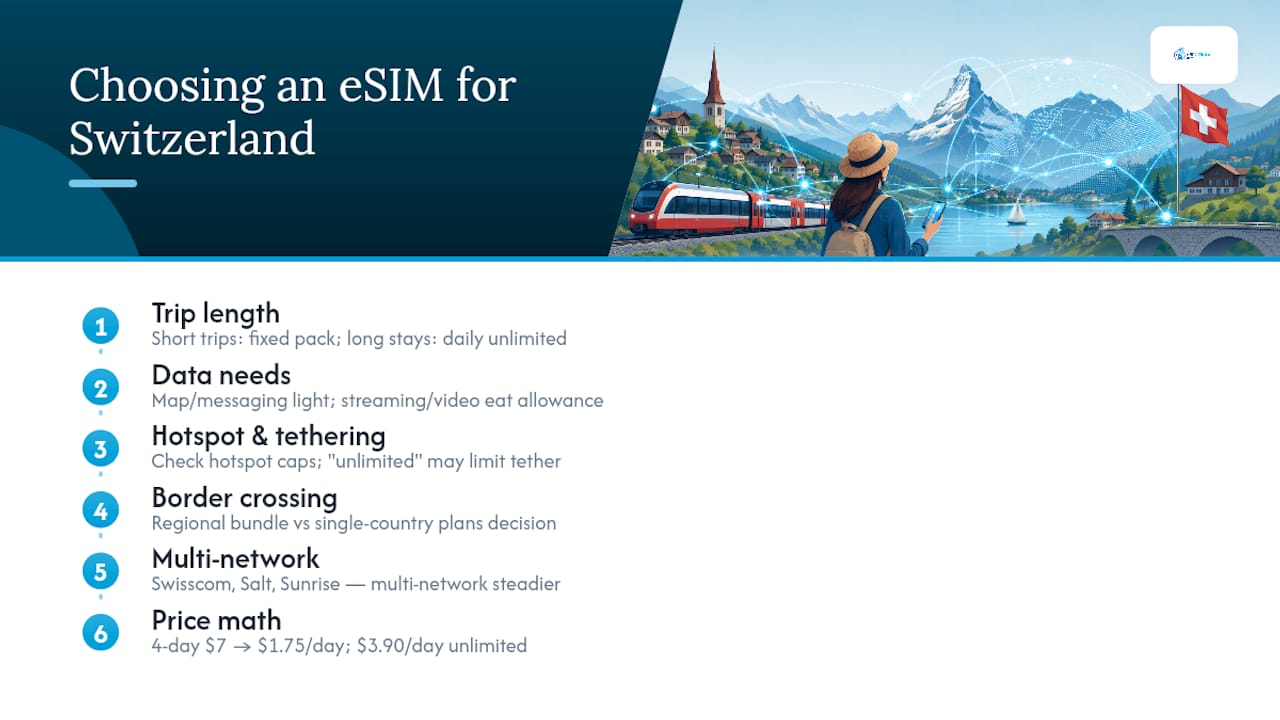
Your decision comes down to four questions, answered in order: how long is the trip, how much data do you actually use, do you need hotspot for a laptop, and are you crossing into other countries. Answer those honestly and the right plan almost picks itself.
Step 1: Trip length. A weekend in Geneva needs a different plan than a month working remotely from Zurich. Short trips (under five days) usually do best with a fixed-data pack sized to your actual habits. Longer stays tend to favor daily unlimited plans, because the per-day cost evens out and you stop worrying about hitting a cap mid-trip.
Step 2: Data needs. Be honest about what you actually do on your phone abroad. Mapping and messaging use very little. Video calls, cloud photo backups, and streaming eat through a fixed allowance fast. If you’re unsure, round up. Running out of data on day three of a five-day trip is a worse experience than paying a couple extra dollars upfront.
Step 3: Hotspot and tethering. If you plan to tether a laptop for work, don’t assume “unlimited” covers it. Hotspot allowances vary widely between plans. Some cap tethered data at around 1 GB per day even inside an otherwise unlimited plan, then throttle speeds after that. If remote work is part of the trip, prioritize plans that state their hotspot allowance clearly rather than guessing from marketing copy.
Step 4: Border crossing. If Switzerland is a single stop on a longer European itinerary, weigh a regional bundle against buying country-specific plans for each stop. Regional plans cost more upfront but remove the hassle of switching eSIM profiles at every border. If you’re staying entirely inside Switzerland, a single-country plan almost always wins on value.
Multi-network access deserves its own mention here, because it matters more in Switzerland than in flatter countries. The Swiss mobile market runs on three main networks: Swisscom, Salt, and Sunrise. Swisscom generally has the widest rural and mountain reach, but coverage in alpine valleys and mountain passes can still be inconsistent no matter which network you’re on, simply because of terrain. Recent provider tests and travel reviews consistently find that plans built on multi-network access, rather than a single carrier agreement, deliver steadier connections in exactly those tricky mountain and rural spots. If your itinerary includes hiking trails, ski resorts, or drives through the Alps, this is the single factor most likely to affect whether your data actually works when you need it.
On price math: compare plans by cost-per-day, not sticker price. A $7 fixed pack that lasts four days works out to $1.75 per day. A $3.90 daily unlimited plan looks pricier at a glance but wins decisively if your trip runs long or your usage is heavy. Run the numbers against your actual trip length before deciding.
Pro Tip: Buy your eSIM at least a day before departure and activate it once, briefly, while still on home Wi-Fi. This confirms the profile installed correctly without burning any of your Swiss data allowance, so you land with a plan you already know works.
Top-up or extension options are offered by some providers if your trip runs longer than planned, so you’re not stuck rebuying a whole new plan from scratch. Check what happens if you need more data before you commit. Support responsiveness matters here too. A plan that’s technically cheaper but leaves you waiting hours for a reply when something breaks isn’t actually the better deal.
What Do Fixed-Data, Unlimited, and Regional Plans Actually Include?
Every eSIM plan for Switzerland falls into one of four categories, and each one solves a different problem. Knowing the mechanics behind each, not just the marketing label, is what keeps you from overpaying or underbuying.
Fixed-data plans sell you a set amount of data, usually somewhere between 3 GB and 10 GB, for a fixed number of days. These work best for short trips with predictable usage: city sightseeing, business meetings, casual social media and maps. Once you hit the cap, the plan either stops working or throttles hard, so sizing this correctly matters more than with any other plan type.
Daily unlimited plans give you a high-speed data allowance that resets every 24 hours, often somewhere in the 1 to 5 GB per day range before speeds drop, rather than a hard stop. Comparisons put typical daily unlimited pricing near $3.90 per day. Do the math against your trip length: a five-day trip at that rate lands under $20, competitive with a mid-size fixed pack but with none of the anxiety about running dry.
Regional and global bundles cover Switzerland plus dozens of other countries in one package. The convenience is real if your itinerary spans borders, but you’re generally paying for flexibility you may not use if your trip stays inside one country. eSIMGlobe’s Europe eSIM collection is worth a look if Switzerland is one stop on a broader European route, and the unlimited-plan collection covers heavier-data travelers who want the daily reset model across a wider footprint.
Phone-number plans, which bundle in calls and SMS on a local or virtual number, matter mainly for travelers who need to receive verification codes or take calls from local contacts. Most short-term visitors don’t need this. A data-only eSIM covers WhatsApp, iMessage, and internet calling for the vast majority of trips, and skipping the voice bundle usually saves money.
A few things to check before buying any plan, regardless of category:
- Confirm the hotspot/tethering allowance in writing on the product page, not just in general marketing language.
- Check whether the high-speed allowance resets daily or is a single pool for the whole trip.
- Look for explicit mention of Swisscom, Salt, or Sunrise network access rather than a vague “European coverage” claim.
- Verify the plan lists Switzerland by name, since some regional bundles quietly exclude non-EU countries.
How Do You Activate an eSIM for Switzerland?
Getting connected takes minutes if you prepare before you fly, and most problems trace back to one of two things: an incompatible device or the wrong data profile switched on.
- Confirm your device supports eSIM. Most iPhones from the XS generation onward and most flagship Android phones from the last several years support eSIM, but carrier-locked phones purchased on contract sometimes have eSIM disabled. Check your phone’s settings under Cellular or Mobile Network for an “Add eSIM” option before you buy anything.
- Purchase and receive your QR code. After checkout, the eSIM Switzerland plan arrives by email, typically within seconds to a few minutes. This is the standard delivery method across the eSIM industry, and it means you can buy at the airport gate if you forgot to plan ahead.
- Install before you fly, activate on arrival. Scan the QR code while still on home Wi-Fi to install the profile, but don’t activate the data plan until you land. This installs the eSIM without triggering the plan’s start date early.
- Switch your active data profile on landing. In your phone’s cellular settings, set the new Switzerland eSIM as your primary data line, or at minimum enable data roaming specifically for that profile. Toggle airplane mode off and back on once to force a fresh network search.
- Confirm connectivity. Check for a data connection indicator and try loading a webpage. If nothing happens within a couple of minutes, manually select network mode instead of relying on automatic selection.
If it doesn’t work right away, work through this quick checklist: confirm the correct eSIM profile is toggled on (not just installed), check that data roaming is enabled specifically for that profile, verify the APN settings match what the provider specifies, and reset network settings if all else fails. Most connectivity issues on arrival come down to one of those four things, not a defective eSIM.
Pro Tip: If your phone shows a signal but no data, the fix is almost always in APN settings, not the SIM itself. Double-check the APN string against what’s listed on your provider’s activation instructions before assuming something’s broken.
If none of that resolves it, contact support. A provider offering 24/7 human support, rather than a ticket queue, turns a potential travel disaster into a five-minute fix.
Should You Get an eSIM or a Physical SIM in Switzerland?
An eSIM wins on convenience for nearly every traveler, but a physical SIM still has a narrow case for very long stays.
eSIM advantages: instant delivery means you can buy from your couch before you even pack. There’s no swapping a tiny physical card in an airport kiosk, no risk of losing your home SIM in the process, and no language barrier at a foreign carrier counter. You keep your home number active for calls and texts while using the eSIM purely for data.
Physical SIM advantages: for stays longer than a month or two, an in-person Swiss carrier SIM can sometimes undercut eSIM pricing, particularly if you’re willing to navigate the purchase process in person and provide ID as required by local registration rules. In-store staff can also troubleshoot device issues directly, which some travelers find reassuring.
On coverage, the comparison mostly comes down to which networks a plan connects to, not whether it’s physical or digital. An eSIM built on solid Swiss network partnerships reaches the same towers a physical SIM from the same carrier would.
When to choose which:
- Short trips (under three weeks): eSIM, without much debate. Faster setup, no logistics, no in-person visit required.
- Long-term stays or relocations: worth comparing a physical Swiss SIM’s monthly cost against a recurring eSIM purchase, especially if you’ll be there for several months.
- Business trips where you need data working the second you land: eSIM, since there’s zero setup time required on Swiss soil.
- Remote work trips needing a reliable local number for banking or appointments: a physical SIM may serve you better long-term, though it costs you the instant-activation advantage.
What Happens to Your Data When You Cross Switzerland’s Border?
Switzerland’s position outside the EU makes border crossings a real consideration, not just a technicality. If you’re driving from France into Switzerland, or taking a train from Italy to Zurich, your EU-based roaming plan generally stops covering you the moment you cross, even though nothing about the train ride itself feels like a border.
The safest approach is buying a plan that names Switzerland explicitly, rather than assuming a broader “Europe” plan includes it. Some regional bundles do cover Switzerland alongside EU countries, but not all of them do, and the exclusion is often buried in the plan’s fine print rather than flagged clearly on the product page.
If your trip runs the other direction, entering the EU after time in Switzerland, the reverse applies: a Switzerland-only plan won’t carry over once you cross into France, Germany, Austria, or Italy. Travelers doing a loop through several countries are usually better served by a regional Europe bundle that explicitly lists Switzerland among its covered destinations, since juggling multiple single-country eSIMs across a fast-moving itinerary gets tedious fast.
Practically, this means checking your route before you buy, not after. A weekend trip entirely inside Switzerland needs nothing more than the Switzerland-specific plan. A road trip touching four countries in ten days needs a regional plan built for exactly that pattern, with Switzerland confirmed as one of the covered countries rather than assumed.
What Actually Matters When Picking a Switzerland eSIM
Most eSIM buying guides treat every provider comparison as a spec sheet contest: gigabytes here, price per day there, a checklist of features nobody actually uses. That misses the point for Switzerland specifically. The real risk isn’t picking a plan with slightly less data. It’s picking a plan that quietly assumes EU coverage extends across the Swiss border, when it doesn’t.
The conventional advice tells you to hunt for the cheapest per-gigabyte rate. I’d argue that’s backward here. The variable that actually breaks trips is network reliability in terrain that isn’t flat, and whether the plan names Switzerland by name rather than folding it into a vague “Europe” bundle. A slightly pricier plan that works reliably in an alpine valley beats a cheaper one that drops out the moment you leave the city.
Prioritize clarity over cost first: confirm Swiss coverage explicitly, check hotspot terms before assuming “unlimited” means what you think it means, then optimize for price once those boxes are checked. Get that order right and the rest of the decision gets a lot easier.
— Daniel
Ready to Buy Your Switzerland eSIM?
eSIMGlobe skips the roaming guesswork entirely: instead of hoping your existing plan quietly covers a non-EU country, you buy coverage built specifically for Switzerland, delivered to your inbox before you’ve finished packing.
The eSIM Switzerland plan is the direct path. On that page, select your data package and day duration based on trip length, confirm your device supports eSIM, and check out in your preferred currency. Delivery lands in your email within seconds to minutes, ready to scan into your phone’s settings.
Before you activate, run through a short checklist: install the QR code while still on home Wi-Fi, wait to activate the plan until you land, and enable data roaming for the new profile specifically. If anything doesn’t connect right away, 24/7 support can often help resolve APN settings or profile issues quickly.
If Switzerland is one stop on a longer European route, the Europe eSIM collection covers a broader footprint in a single purchase. Either way, the checkout process takes less time than finding a SIM kiosk at the airport.
Sources and Further Reading on Switzerland eSIM Options
A few resources worth bookmarking alongside this guide, whether you’re finalizing your plan choice or troubleshooting after arrival:
- Essential eSIM facts every traveler should know for a broader rundown on device compatibility and setup basics.
- eSIM travel tips: stay connected abroad easily and affordably for a general checklist that applies well beyond Switzerland.
- Data-only eSIM plans: best options for travelers if you’re deciding between data-only and phone-number plans.
- For travelers pairing mobile data with lodging logistics, this guide to booking a weekend stay covers how reliable connectivity backs up spotty hotel Wi-Fi.
FAQ
Is Airalo eSIM good in Switzerland?
Global eSIM providers vary in how they handle non-EU countries like Switzerland, and coverage quality depends on which local networks they partner with. The safer approach for Switzerland specifically is choosing a plan that names Swiss network access explicitly, like eSIMGlobe’s Switzerland-specific plan, rather than assuming a general Europe plan carries the same reliability.
Which eSIM is best for traveling to Europe, including Switzerland?
If your trip stays entirely inside Switzerland, a single-country plan like eSIMGlobe’s Switzerland eSIM gives better value per country. If you’re crossing into other European countries, a regional bundle such as the Europe (30+ areas) collection covers multiple stops in one purchase, as long as Switzerland is confirmed among the listed countries.
Which SIM card is best in Switzerland for tourists?
For most tourists, an eSIM beats a physical SIM on convenience: it delivers by email before you even leave home and activates without visiting a store. A physical SIM only pulls ahead for stays longer than a month or two, where in-person pricing can sometimes undercut a recurring eSIM purchase.
How long does eSIM activation take in Switzerland?
Delivery is typically instant, arriving by email within seconds to a few minutes of purchase. Full connectivity on arrival usually takes just a couple of minutes once you toggle on the correct data profile and reset your network connection.
Do I need a Switzerland-specific eSIM, or will a general Europe plan work?
Since Switzerland is outside the EU, some Europe-labeled plans quietly exclude it. Check that Switzerland is explicitly listed on the plan’s coverage page, or choose a Switzerland-specific product like eSIMGlobe’s dedicated plan to remove the guesswork entirely.