






















For most travelers, the best eSIM for Saint Vincent and the Grenadines is EsimGlobe’s dedicated Saint Vincent & Grenadines plan, delivered by email in seconds with a QR code you can activate before you even land. It routes over local Flow and Digicel towers, so you skip the arrivals-hall SIM kiosk entirely. Island-hoppers or heavy streamers can consider global unlimited options that cover multiple Caribbean stops without a new purchase at every port.
TL;DR:
- Travelers on short stays under two weeks benefit most from an eSIM activated upon landing to avoid airport kiosk lines and ensure immediate connectivity.
- The regional Caribbean 20+ plan offers better value for travelers visiting multiple Caribbean countries rather than staying within Saint Vincent and the Grenadines.
- Coverage varies significantly between Flow and Digicel, with Flow performing better in Saint Vincent and tourist areas, and Digicel often stronger on outlying islands like Bequia.
- For longer stays exceeding a month or heavy daily data use, purchasing a local Flow or Digicel SIM becomes more cost-effective due to lower per-gigabyte prices.
- Most eSIMs, including EsimGlobe’s, are data-only; get a local physical SIM if a local phone number for calls is necessary during your trip.
Table of Contents
- Which EsimGlobe eSIM Fits Your Saint Vincent Trip?
- eSIM or Local SIM: Which One Should You Buy?
- How Reliable Is Coverage Across the Grenadines?
- How Much Data Do You Actually Need for a Short Trip?
- How Do You Install and Activate Your eSIM?
- Staying Connected Between Islands and on the Water
- What Makes EsimGlobe a Solid Choice for This Trip?
- What Actually Matters When You’re Choosing an eSIM Here
- Ready to Connect the Moment You Land in Saint Vincent
- Sources Behind This Guide
- FAQ
Which EsimGlobe eSIM Fits Your Saint Vincent Trip?
Not every traveler needs the same data plan, and matching the product to the trip is where most people either overpay or run out of gigabytes on day four. The two clearest paths are a destination-specific plan for a single-island or short-stay visit, and a broader unlimited plan for anyone bouncing between Bequia, Union Island, Mustique, and the mainland.
The eSIM Saint Vincent & Grenadines product is the default recommendation for the majority of visitors. It’s built for exactly this trip: a data-only profile sized for a week or two, delivered instantly, with no contract and no store visit. Because it activates on arrival, you land, connect, and start navigating from the airport without hunting for Wi-Fi or standing in a kiosk line.
The alternative worth knowing about is the eSIM Saint Vincent and the Grenadines Unlimited Day Pass, which suits travelers who stream video, run navigation constantly, or work remotely and can’t risk hitting a data cap mid-afternoon. If your itinerary spans several Caribbean nations rather than staying within the Grenadines chain, the eSIM Caribbean 20+ collection covers a wider footprint under one purchase.
Here’s how the choice typically breaks down by traveler type:
- Short beach or cruise stopover (3 to 7 days): the standard Saint Vincent & Grenadines plan in a smaller data size covers maps, messaging, and social posting comfortably.
- Sailing charter or multi-island itinerary: the unlimited day pass removes the anxiety of tracking usage while hopping between Bequia, Canouan, and Mustique.
- Business travelers needing constant connectivity: the unlimited option again wins, since video calls and cloud file access chew through data fast.
- Regional trip touching multiple Caribbean countries: the Caribbean 20+ collection avoids buying a separate eSIM at every border.
- Digital nomads staying a month or more: a smaller EsimGlobe plan for the first 48 hours, paired with a local SIM once settled, usually costs less over time.
Providers that publish clear coverage details and offer round-the-clock support tend to be a more dependable choice for island-hopping itineraries, and that’s a useful standard to consider regardless of plan size.
eSIM or Local SIM: Which One Should You Buy?
The decision comes down to three questions: how long are you staying, how much data do you burn through, and do you need a local phone number for calls. Get those three answered and the rest is easy.
- Trip of 10 days or less, especially multi-island — buy an eSIM. Travel guidance consistently favors eSIMs for short stays because they activate the moment you land, and you avoid the risk of arriving to a closed airport kiosk outside scheduled flight hours.
- Stay longer than a month, or you’re a heavy daily data user — a physical Flow or Digicel SIM usually wins on price per gigabyte once you’re past the two or three week mark.
- You need a local number for hotel bookings, boat charters, or business contacts — plan to add a local SIM within a day of arrival, since most eSIM data plans, including EsimGlobe’s, are data-only and don’t include a west Indies phone number.
A sensible middle path many travelers use: land with an eSIM active from the moment the plane’s wheels touch down, then pick up a local SIM in Kingstown or Port Elizabeth only if the trip stretches past ten days or you specifically need voice minutes with a St. Vincent number. That combination handles both the convenience problem and the cost problem without overpaying for either.
Pro Tip: If you’re only doing a week-long sailing loop through the Grenadines, skip the local SIM search entirely. The setup and swap time alone often costs more than the money you’d save on data.
Read more on the trade-offs in eSIM vs local SIM: what travelers should know if you want the fuller cost breakdown before deciding.
How Reliable Is Coverage Across the Grenadines?
Coverage in Saint Vincent and the Grenadines isn’t uniform, and pretending otherwise sets you up for a bad surprise on a small cay. Flow tends to deliver stronger signal on the main island of Saint Vincent and around the busier tourist areas near Kingstown. Digicel, by contrast, often performs better once you’re out on Bequia and Union Island, where its network has historically had a stronger local footprint.
Neither carrier guarantees a strong signal everywhere. Expect genuine dead zones on smaller cays like Mayreau or the outer Tobago Cays, and don’t count on connectivity while at sea between islands. This is normal for the region, not a defect in any particular eSIM, and it’s worth building into your day’s plan rather than discovering it mid-crossing.
Signal mapping tools that test real-world network performance show meaningfully variable strength across the island chain, which is worth checking for your specific route before you commit to a plan size.
Before you buy or activate, run through this checklist:
- Confirm your phone model and year actually support eSIM. Most flagship phones from the last several years do, but budget and carrier-locked models sometimes don’t.
- Check that your device is unlocked. A carrier lock from your home network can block a new eSIM profile from connecting even if the phone itself supports the technology.
- Update to the latest OS version before you leave. eSIM installation on older software versions is one of the most common failure points travelers report.
- Understand your phone’s dual-SIM behavior. iOS and Android handle default data/voice line switching differently, and setting the wrong line as primary is a frequent source of “no data” complaints.
- Verify band support for the region if you’re using an older or imported handset, since coverage depends on your phone speaking the same frequency bands as Flow or Digicel towers.
Because coverage genuinely shifts by island, choosing a plan that draws on both major networks rather than locking you to one carrier gives you a real practical edge when your itinerary includes more than the mainland.
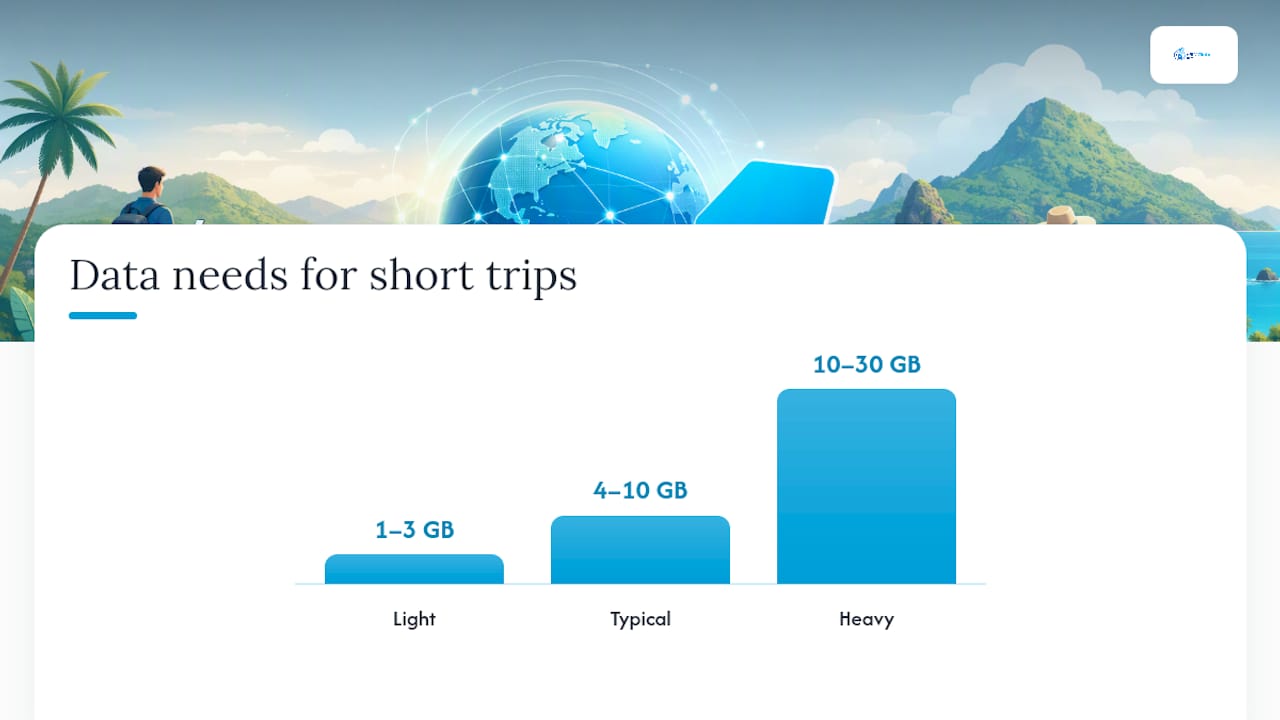
How Much Data Do You Actually Need for a Short Trip?
Guessing your data needs is where most travelers either overspend on an oversized plan or run dry two days before their flight home. Comparison databases tracking this destination list a wide spread of plans, sometimes numbering in the dozens to hundreds across providers, which tells you there’s real room to match plan size to actual usage instead of grabbing the first option you see.
Break your needs into three rough buckets:
- Light (1 to 3 GB): covers maps, WhatsApp, email, and occasional photo uploads over a 3 to 5 day trip. Fine for someone mostly offline and relying on hotel or resort Wi-Fi.
- Typical (4 to 10 GB): the sweet spot for most leisure travelers on a week-long trip who want to stream music, post photos daily, and navigate without worrying about the meter.
- Heavy (10 to 30 GB): suited to remote workers on video calls, anyone streaming video regularly, or families sharing one hotspot connection across multiple devices.
Pricing for short-stay plans on this route runs from a few dollars for small data packages up to considerably more for larger or longer-validity bundles, and regional or unlimited plans cost more upfront but remove the need to track usage entirely. That trade-off matters most if your itinerary crosses several islands or countries in one trip, where a regional plan can work out cheaper than buying separate country plans at each stop.
One more practical point: buying before you fly beats waiting to arrive. Airport kiosks keep hours tied to scheduled flights, and if you land outside that window, you could be sitting offline until morning. Purchasing your eSIM ahead of departure and letting it sit ready to activate removes that risk completely, and it costs nothing extra to do it early.
How Do You Install and Activate Your eSIM?
Getting connected takes about five minutes if you do it in the right order, and most of the “my eSIM isn’t working” complaints trace back to skipping a step.
- Buy before departure. Select the Saint Vincent & Grenadines product, complete checkout, and the QR code arrives in your email almost immediately. Keep your home SIM active in your phone until the new eSIM is fully installed and tested.
- Install the profile. Scan the QR code in your phone’s cellular settings, give the new eSIM profile a clear label like “SVG Travel” so you don’t confuse it with your home line, and set your cellular data to route through the new profile while keeping your home line for calls and texts if needed.
- Confirm settings before you fly. Check that data roaming is turned on for the new eSIM specifically, and if your phone supports dual-SIM, make sure the new profile is set as your default for data. A reboot after installation clears up most connection hiccups.
If the eSIM won’t connect once you land, work through these fixes in order: manually select the network operator instead of leaving it on automatic, toggle data roaming off and back on, double check the APN settings match what was provided at purchase, and if none of that works, delete and reinstall the profile from the original QR code. EsimGlobe’s support line runs 24/7 specifically because activation issues tend to happen at odd hours for travelers crossing time zones, and a quick message usually resolves what a reboot alone can’t.
Pro Tip: Screenshot your QR code and save it to your photos before you leave home Wi-Fi. If your email doesn’t load on arrival, you’ll still have the code saved locally.
Staying Connected Between Islands and on the Water
Ferries and private boats between Saint Vincent, Bequia, Canouan, and the smaller cays are where connectivity gets genuinely unpredictable, and no eSIM or SIM card fixes physics. Once you’re a few miles offshore, expect your signal to drop entirely until you’re back within range of a tower.
Plan around it rather than fighting it. Download offline maps for each island before you leave port, and save any documents, boarding passes, or hotel confirmations you’ll need locally so a dead zone at the wrong moment doesn’t strand you without them.
For redundancy on longer multi-island trips, a few combinations work well depending on your pattern:
- EsimGlobe plan plus a backup local SIM: buy the local SIM once you reach the main island if you know you’ll be island-hopping for more than a week.
- Unlimited day pass alone: simplest option if you don’t want to think about data caps while you’re moving between four or five stops in a single trip.
- Regional Caribbean plan: worth it if your route extends beyond the Grenadines into neighboring countries.
Battery management matters just as much as signal. Using your phone as a hotspot for a laptop or tablet on a boat under direct sun drains a battery fast, so carry a portable charger and switch to low-power mode when you know you’re heading into a stretch with no coverage. This is also good general practice for managing connectivity during business travel, where staying reachable without burning through your device matters just as much on a work trip as a vacation.
What Makes EsimGlobe a Solid Choice for This Trip?
A core promise across many eSIM providers is that you pick your country, pay, and receive an activation-ready QR code by email, usually within seconds. For Saint Vincent and the Grenadines specifically, that means you can complete the entire purchase and setup from your couch at home, days before you fly.
A few specifics worth knowing before you buy:
- Instant delivery. The QR code lands in your inbox immediately after checkout, with no waiting period or manual approval step.
- Country-specific plans. Rather than a generic regional bundle, the Saint Vincent & Grenadines product page is built specifically for this destination’s network setup.
- Multi-currency checkout. You can pay in USD, EUR, GBP, and other currencies depending on where you’re purchasing from, which matters if you’re comparing prices across sites in different currency displays.
- QR-code activation. No physical SIM tray, no store visit, no waiting for a card to ship.
- 24/7 support. Connectivity problems don’t wait for business hours, and neither does the support line.
For travelers whose plans extend past a single island or country, the Global (130+ areas) eSIM and its unlimited counterpart offer a wider net without forcing a new purchase decision at every border crossing. Between the destination-specific plan and the broader global options, most trip patterns to this part of the Caribbean are covered without needing to piece together data from multiple providers.
What Actually Matters When You’re Choosing an eSIM Here
The convenience-versus-cost debate around eSIMs gets treated like a simple math problem, and that’s the wrong frame for most trips to Saint Vincent and the Grenadines. A five-dollar difference in per-gigabyte pricing means nothing if you spend your first afternoon standing in an airport kiosk line while your hotel checks in without you.
Where the calculation genuinely shifts is trip length. Under two weeks, arrival convenience wins almost every time, because the hours saved not hunting for a SIM card vendor are worth more than the marginal savings a physical local SIM offers. Past the three or four week mark, that math flips, and a Flow or Digicel SIM purchased locally starts paying for itself in lower per-GB rates.
The nuance most guides skip: you don’t have to pick one and commit for the whole trip. Landing with a small eSIM active, then switching to a local SIM only if your stay stretches longer than planned, gives you the arrival convenience without locking you into paying premium data rates for a month-long stay you didn’t originally book. Flexibility, not brand loyalty to one connectivity method, is what actually serves most travelers well here.
— Daniel
Ready to Connect the Moment You Land in Saint Vincent
eSIMGlobe skips the airport kiosk line entirely. Where a local SIM purchase means finding a Flow or Digicel counter after you clear customs, EsimGlobe’s Saint Vincent & Grenadines plan arrives in your inbox before you even board your flight, ready to scan and activate the second your plane touches down.
Buy the eSIM Saint Vincent & Grenadines plan for a standard single-island or short Grenadines trip, or step up to the eSIM Global (120+ areas) Unlimited if your route covers several Caribbean stops or you simply don’t want to think about a data cap while you’re on vacation. Either way, the checklist is short: pick your plan, check out, save the QR code to your phone before you leave home Wi-Fi, and activate once you land. Support runs 24/7 if anything doesn’t connect on the first try, and every plan ships instantly by email with no physical card to wait for.
Sources Behind This Guide
- Saint Vincent and the Grenadines SIM Card & eSIM travel guidance — supports the recommendation to buy before departure and the trade-off between eSIM and local SIM by trip length.
- esims.io country comparison — confirms the wide spread of plans and prices available for this destination.
- nPerf global signal mapping — a useful tool for spot-checking real-world signal strength on specific islands before you travel.
FAQ
What Is the Best eSIM to Use in the Caribbean?
For Saint Vincent and the Grenadines specifically, EsimGlobe’s dedicated country plan is the strongest single-destination option because it routes over both Flow and Digicel networks. Travelers covering multiple Caribbean nations in one trip generally get better value from a regional plan like the Caribbean 20+ collection instead of buying a new eSIM at every stop.
Which eSIM Provider Is the Most Trusted?
Trust in this category comes down to instant delivery, transparent coverage information, and real support availability rather than marketing claims. EsimGlobe publishes country-specific coverage details and offers 24/7 support, which are the two factors travel guidance consistently flags as the strongest reliability signals for island-hopping itineraries.
Is It Safe to Travel to Saint Vincent Right Now?
General safety conditions can change, so check current travel advisories from your home country’s foreign affairs department before booking. From a connectivity standpoint, the islands are well served by Flow and Digicel, and having an active eSIM from the moment you land makes it easier to reach emergency services, hotels, or family if needed.
Who Has the Best eSIM Plan for a Short Trip?
For trips of three to ten days, the standard Saint Vincent & Grenadines eSIM sized to the typical 4 to 10 GB bucket covers most travelers’ navigation, messaging, and social sharing needs. Heavier users or multi-island sailors tend to prefer the unlimited day pass to avoid tracking data while moving between stops.
Do I Need a Local Phone Number Alongside My eSIM?
Most eSIM plans, including EsimGlobe’s, are data-only and don’t include a Vincentian phone number. If you need one for hotel bookings, boat charters, or local contacts, plan to pick up a physical Flow or Digicel SIM within a day of arrival alongside your eSIM.