






















The best eSIM Belarus travel plan is one that discloses access to more than one local network, because dead zones outside Minsk remain a real problem on single-network plans. Esimglobe stands out for this reason, pairing dual-network access with instant email delivery. Short-stay visitors do fine with a lighter single-network plan for value, and travelers on a strict budget can find entry options at low prices if they accept the coverage tradeoff.
TL;DR:
- Choosing a dual-network eSIM like Esimglobe offers better coverage, especially outside Minsk, by automatically switching between carriers like MTS and A1.
- Longer validity plans, such as 30-day options, typically provide a better price per GB compared to stacking multiple short-term bundles.
- Activation is quick with instant email delivery of QR codes, but confirm device compatibility and whether hotspot tethering is supported before purchase.
- For rural or multi-city trips, plans featuring Life:) or dual-network access significantly reduce dead zones and signal drops.
- Regional Europe bundles may cost more but are useful if your trip spans multiple countries, whereas single-country Belarus plans stop working once you cross borders.
Table of Contents
- Best eSIM Belarus Options at a Glance
- What Each Recommended Belarus eSIM Plan Actually Delivers
- How to Choose the Right Belarus eSIM for Your Trip
- Activating an eSIM in Belarus: Compatibility and Quick Fixes
- Why Esimglobe Stands Out for Belarus Travel
- Roaming Costs and International Data Options With a Belarus eSIM
- Customer Support Quality and Language Coverage
- Author Perspective: When Redundancy Is Worth Paying For
- Get Your Esimglobe Belarus Plan Before You Travel
- Sources for Checking Live Belarus Coverage
- FAQ
Best eSIM Belarus Options at a Glance
Belarus eSIM comparison engines track hundreds of plans, with prices for small entry-level bundles starting around $3 and climbing toward premium territory for high-data or unlimited options. That spread makes side-by-side comparison the only sane way to shop, because two plans priced within a dollar of each other can differ wildly in validity, GB allowance, and which local carriers actually carry your signal.
The table below lines up the strongest picks from this roundup against the dimensions that actually change your trip: price, data, validity, disclosed networks, hotspot support, and how fast you’re online after buying.
A few things jump out once the numbers sit side by side:
- Price-per-GB drops fast on 30-day plans compared to 7-day equivalents, so a longer validity window usually beats buying two short bundles back to back.
- Providers that name MTS, A1, or Life:) by name are giving you something the cheapest 1GB entries rarely do: a fallback signal when the primary carrier goes quiet.
- Hotspot access is close to standard now, but a few budget entries cap tethering or block it outright, so check before you count on it for a laptop.
- The cheapest sticker price is not the cheapest plan once you divide by GB and account for validity length.
What Each Recommended Belarus eSIM Plan Actually Delivers
Headline prices tell you almost nothing until you know what network sits behind them. Here’s what each option in this comparison brings to the table, plan by plan.
Esimglobe runs a Belarus product line built around short-stay and multi-day tiers, including a 1GB/7-day plan for light users and larger 10GB and 20GB bundles for longer visits.
- Multi-network access is disclosed on its Belarus offering, which matters most once you leave Minsk’s dense coverage zone.
- Delivery is instant by email with a QR code, so there’s no app install required before you fly.
- Hotspot and tethering are supported on its data plans, useful if you’re sharing a connection with a travel companion.
- 24/7 support is available in multiple languages, which helps when an activation hiccup happens at a border crossing rather than a help desk.
Nomad built its Belarus reputation on explicit MTS plus A1 dual-network access, the same redundancy argument driving this whole comparison.
- Plan tiers run from roughly 10GB/30 days to 20GB/30 days, aimed squarely at travelers who need more than a week of coverage.
- The dual-network setup is the standout here: if MTS drops in a rural stretch, A1 can pick up the slack automatically.
- Activation is instant through app or QR, and hotspot use is permitted.
- Best suited to multi-city itineraries or road trips where you can’t predict which carrier will have the strongest tower.
Ubigi carries access to Life:), the Belarusian carrier known for reaching pockets of the countryside where A1 and MTS both thin out.
- Plan sizes land in the 3GB to 10GB range with validity windows between 7 and 30 days.
- Life:) access is the differentiator, not raw price, so this fits travelers heading somewhere off the main highway corridors.
- Hotspot is supported, and activation is instant via QR code.
- Best for short stays that still need a rural safety net.
Saily shows up in several comparison indexes as a balanced middle-of-the-road option for general tourism.
- Bundles range from 3GB to 20GB with standard 7 to 30 day validity.
- Network disclosure is thinner than Nomad’s or Ubigi’s, so treat it as a single-network plan unless the checkout page states otherwise.
- Fine for a straightforward city visit to Minsk where coverage density isn’t a concern.
eSIMX offers a handful of mid-range Belarus tiers between 5GB and 15GB.
- Multiple validity windows give some flexibility for trips that run longer than a week but shorter than a month.
- Single network disclosed, adequate for urban and near-urban travel.
- Standard instant QR activation.
eTravelSim leans into regional Europe bundles that happen to include Belarus among covered countries.
- Data tiers run larger, often 10GB to 20GB, aimed at travelers hopping between several European countries on one itinerary.
- Useful if Belarus is one stop on a longer regional trip rather than the sole destination.
AlpineSIM advertises high-data and daily unlimited options, a fit for heavy streamers or remote workers who burn through gigabytes fast.
- Daily unlimited caps solve the “will I run out of data” anxiety, though pricing runs higher than fixed-GB competitors.
- Best for short bursts of intensive use rather than a full month abroad.
GigSky, Yesim, GoMoWorld, aloSIM, GlobaleSIM, Roamless, Orange Travel, and eSIM4Travel round out the market with smaller starter bundles, short-stay flexibility, and regional variations on the same basic formula: pay for data, install a QR code, connect.
- GigSky and Yesim target trial users and very short stays with small entry bundles.
- GoMoWorld and aloSIM focus on short-validity, budget-first pricing.
- Airalo frequently posts the cheapest 1GB entries in aggregator rankings, appealing to travelers passing through for a day or two.
- eSIM4, an editorial comparison site rather than a carrier itself, curates top Belarus picks for readers who want a second opinion layered on top of raw pricing.
How to Choose the Right Belarus eSIM for Your Trip
Match the plan to your actual itinerary before you look at price. A weekend in Minsk and a two-week loop through smaller towns call for different priorities entirely.
- Short city stay (3-5 days): A 3GB or 10GB, 7-day plan on a single disclosed network covers maps, messaging, and light streaming without overpaying for unused data.
- Rural or multi-city travel: Prioritize a provider disclosing MTS plus A1 fallback, or Life:) access if your route runs through the countryside.
- Long-stay or digital nomad work: A 30-day plan with 20GB or more brings the price-per-GB down substantially compared to stacking multiple 7-day bundles.
- Strict budget, short stopover: A sub-$5 entry tier works fine if you’re only checking email and using maps for a day or two.
Before buying, ask three questions: which local carriers does the eSIM actually use, does the plan support hotspot tethering, and how is the eSIM delivered (instant email QR versus app-based setup that eats into your arrival time)?
Pro Tip: Calculate price-per-GB by dividing the total price by the GB allowance, then compare that number across plans instead of comparing sticker prices directly. A $15 plan with 10GB beats a $10 plan with 3GB every time you actually use your phone.
Watch for red flags: vague “unlimited” claims with no fair-use policy stated, no mention of which carrier you’ll connect to, and validity windows that start counting from purchase rather than activation.
Activating an eSIM in Belarus: Compatibility and Quick Fixes
Getting connected takes minutes once you know the sequence. Install and activate your eSIM before you land, not after, to avoid searching for Wi-Fi at the airport.
- Buy your plan online and receive the QR code by email within minutes.
- Scan the QR code through your phone’s cellular settings menu, or enter the activation details manually if your device doesn’t support scanning.
- Enable the new eSIM profile and set it as your data line, keeping your home SIM active for calls if needed.
- Confirm eSIM compatibility first: most iPhones from the XS generation onward and recent Android flagships support it, but some carrier-locked or older devices don’t.
- If the connection drops, check whether the plan discloses a fallback network. Toggle Airplane Mode on and off to force a network re-search, or contact support if the profile won’t activate at all.
Why Esimglobe Stands Out for Belarus Travel
Esimglobe’s product catalog spans more than 170 countries, with a dedicated Belarus line running from a 1GB/7-day starter to larger multi-week bundles. That scale matters less than what it enables: a single checkout flow, one currency, and a support line that doesn’t change depending on which country you’re visiting next.
The practical case for dual-network access plays out clearly on rural routes. A traveler driving between Minsk and a smaller regional city can lose signal on one carrier for stretches at a time; a plan with automatic fallback to a second network closes that gap without any manual switching.
Network redundancy isn’t a marketing flourish. It’s the difference between a dead map screen on a highway outside Minsk and one that keeps updating.
Esimglobe’s own write-up on avoiding dead zones with a dual-network eSIM walks through this exact scenario in more detail for travelers planning routes beyond the capital.
Roaming Costs and International Data Options With a Belarus eSIM
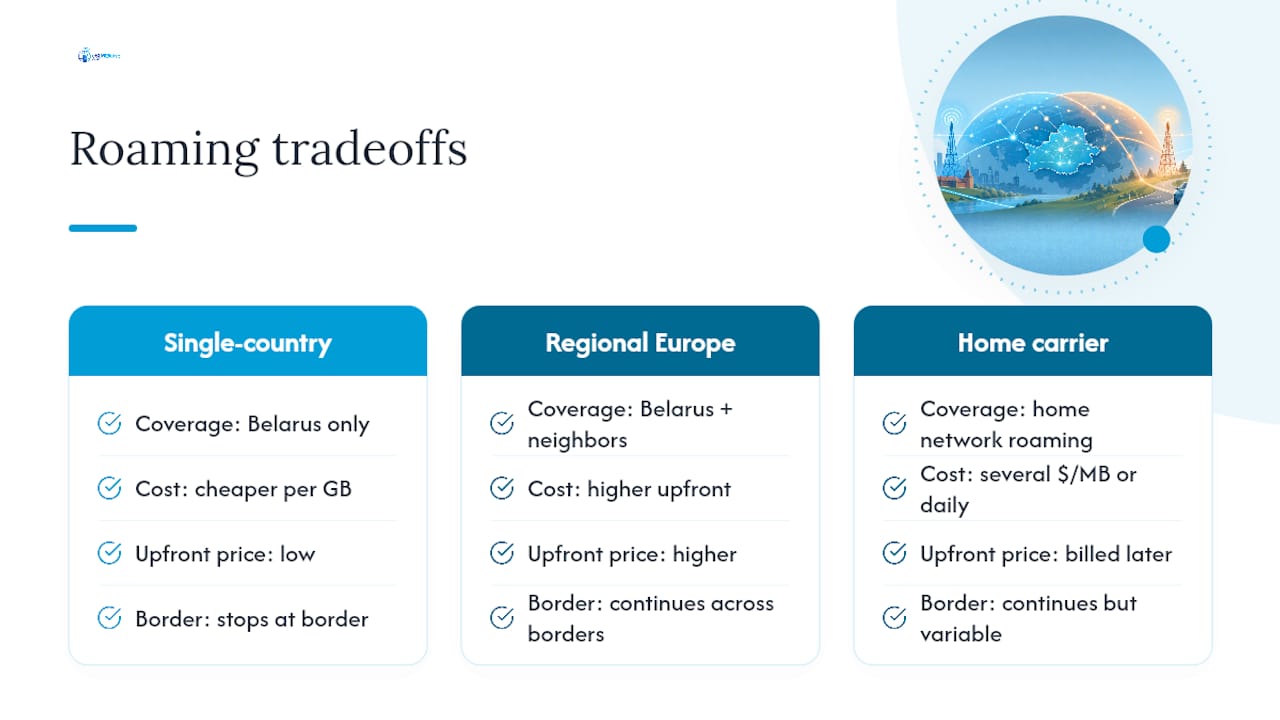
An eSIM bought for Belarus works only inside Belarus unless the provider explicitly sells a regional bundle. That distinction trips up a lot of first-time buyers who assume “Europe eSIM” automatically includes every country on the continent.
If your trip continues into neighboring countries, a regional Europe plan from providers like eTravelSim covers Belarus alongside other destinations under one bundle, which usually costs more upfront but saves you from buying two separate eSIMs. A single-country Belarus plan, by contrast, is cheaper per GB but stops working the moment you cross a border.
Roaming charges from your home carrier are the real cost to compare against. Traditional roaming often runs several dollars per megabyte or a flat daily fee that adds up fast on a two-week trip, while a prepaid eSIM plan locks in your data cost before you leave. There’s no per-minute or per-MB surprise on your next phone bill.
If your itinerary includes Russia, coverage claims deserve extra scrutiny. Some providers advertise Belarus and Russia together in one regional bundle, but network access and reliability between the two countries vary by carrier agreement, so confirm the specific networks disclosed for each country rather than assuming one plan covers both equally well.
Customer Support Quality and Language Coverage
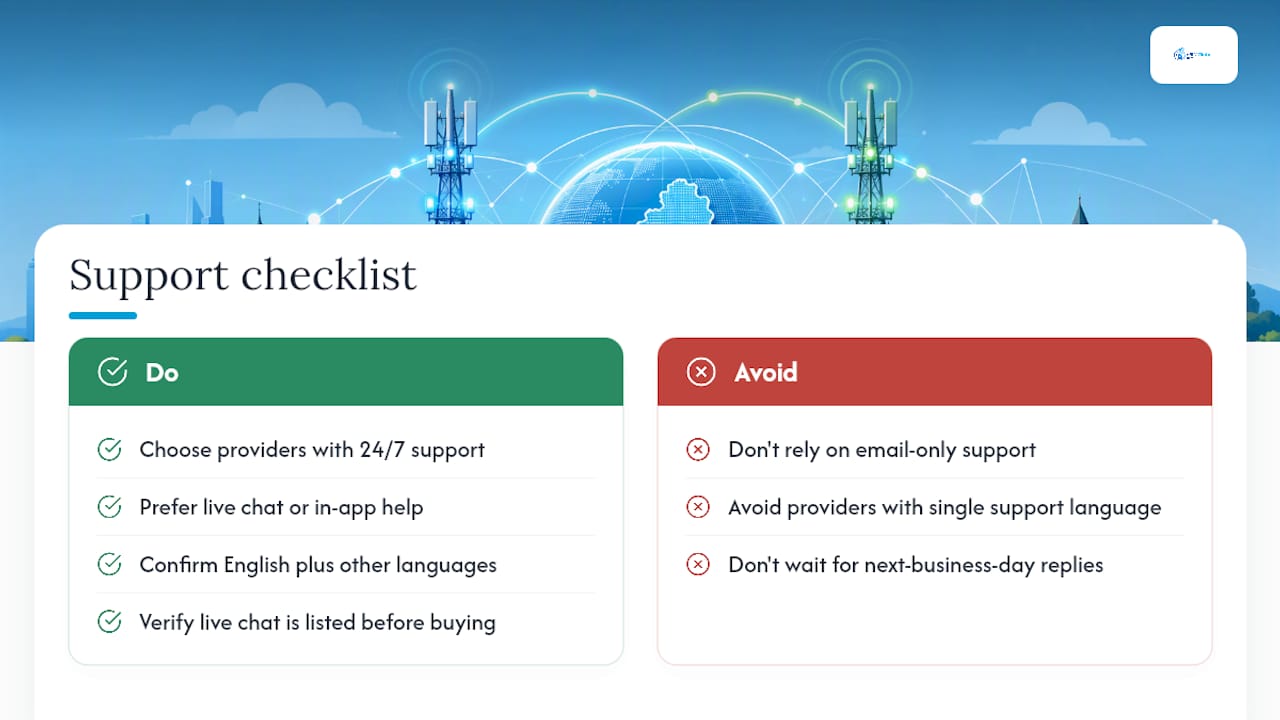
Support quality separates a smooth trip from a stressful one when an eSIM won’t activate at the airport. Esimglobe runs 24/7 support, which matters most in the first hour after landing, when a failed activation needs a fast answer rather than a next-business-day email reply.
Language coverage varies by provider. Larger platforms typically offer English-language support as standard, with some extending to additional languages through chat or email. Smaller regional providers sometimes rely on a single support language, which can slow things down if English isn’t your first language and the provider’s team doesn’t speak yours.
Response channels matter as much as language. Email-only support means waiting for a reply while your data plan sits inactive; live chat or in-app support resolves activation issues in real time, which is the difference that counts when you’re standing at a taxi stand trying to load a map.
Before buying, check whether the provider lists a live chat option or app-based help center, not just a contact email buried in the fine print. That single detail often predicts how your first day in Belarus will actually go.
Author Perspective: When Redundancy Is Worth Paying For
The instinct to grab the cheapest 1GB plan makes sense for a two-day layover. It stops making sense the moment your itinerary includes anything outside Minsk’s city center, because single-network coverage in Belarus thins out fast once you’re past the ring road.
I’d pay the modest premium for a dual-network plan on any trip longer than four or five days, or any trip that includes rural driving, regional trains, or a visit to a smaller city. The math favors redundancy: a dropped connection costs you more in frustration and lost time than the few extra dollars a multi-network plan adds to the bill.
For a straightforward weekend in the capital, a cheaper single-network entry is perfectly reasonable. Esimglobe’s Belarus eSIM product page lays out both options side by side, which makes that call easier to make before you leave home.
— daniele
Get Your Esimglobe Belarus Plan Before You Travel
Esimglobe gives you a purchase-ready alternative to hunting through a dozen provider sites for the one that actually discloses its network setup. Its Belarus lineup covers a 1GB/7-day starter for short visits, a day-pass or unlimited option for heavy single-day use, and 10GB or 20GB multi-day bundles for longer stays.
Every plan arrives by email within minutes of checkout, with a QR code ready to scan the moment you land. Esimglobe backs each purchase with 24/7 support, telecom-grade security, and checkout in your own currency, whether that’s USD, EUR, or GBP.
If your route includes anything beyond Minsk’s city limits, the dual-network disclosure on Esimglobe’s Belarus plans is the detail worth checking first. Visit the Belarus eSIM plans page to compare tiers and activate before your trip.
Sources for Checking Live Belarus Coverage
Prices and network claims shift, so verify coverage close to your travel date rather than relying on last year’s comparison post.
- nPerf’s signal maps show real-world performance differences between A1, MTS, and Life:) by region, useful for confirming rural coverage before you commit to a plan.
- Comparison engines tracking hundreds of Belarus eSIM listings help you sanity-check pricing against the examples in this guide.
- App store listings for provider apps often carry recent user reviews that flag activation problems faster than a provider’s own marketing page.
- If you’re planning a route outside major cities, cross-reference a coverage map against your specific stops, not just the country as a whole.
FAQ
Is It Safe to Travel to Belarus Right Now?
Travel advisories change, so check your home country’s current government travel advisory before booking; this article covers eSIM connectivity only and isn’t a substitute for official guidance.
What Is the Most Trusted eSIM for Belarus?
Trust comes down to network disclosure and support quality rather than brand recognition alone. Esimglobe’s Belarus plans disclose multi-network access and back it with 24/7 support, which is the combination worth prioritizing over the cheapest sticker price.
Which Is Better for Europe, Airalo or Orange Travel?
Both are single-network-leaning options aimed at budget or short-stay travelers, and neither publishes the same multi-network disclosure that a Belarus-specific dual-network plan offers. For Europe-wide trips that include Belarus, a plan disclosing local carrier fallback tends to hold up better outside major cities than either of these.
Which eSIM Works Best in Russia?
Coverage and carrier agreements for Russia differ from Belarus, so confirm the specific networks a provider discloses for Russia rather than assuming a Belarus plan or bundle extends the same reliability across the border.
How Fast Can I Activate a Belarus eSIM After Buying?
Most providers, including Esimglobe, deliver the eSIM QR code by email within minutes of purchase, letting you install and activate it before you even board your flight.